
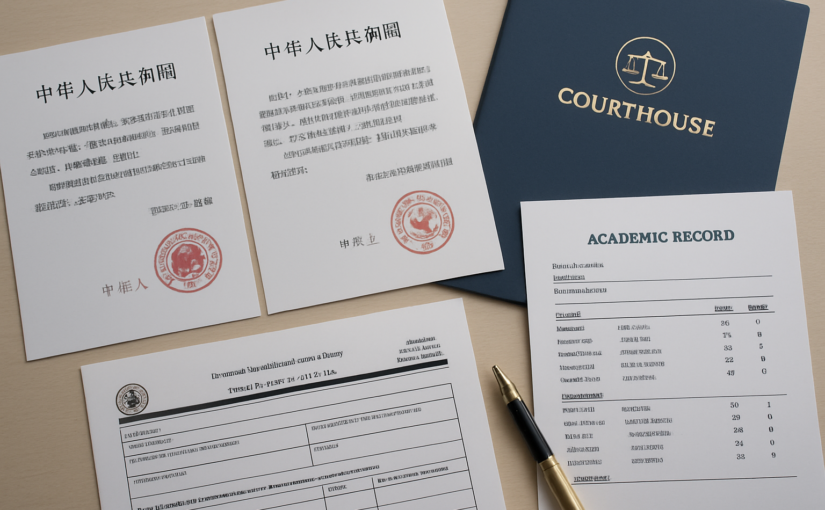
Certified Chinese Translation for USCIS, Courts, Schools, and Business Records
If you need a certified Chinese translation, one of the first questions you may face is surprisingly complex: do you need Simplified Chinese or Traditional Chinese? And if the document is tied to spoken language, does it matter whether it is Mandarin or Cantonese?
These questions matter because Chinese is not a single, uniform language in the way many people assume. A document from mainland China may look very different from one issued in Hong Kong or Taiwan. A birth certificate, hukou, marriage certificate, diploma, police record, contract, or court filing may use different character sets, regional terminology, or administrative formats. If your translation is for USCIS, a U.S. court, a university, or a business transaction, the wrong approach can lead to delays, rejections, or requests for clarification.
This guide explains how certified Chinese translation works, the difference between Simplified and Traditional Chinese, how Mandarin and Cantonese fit into the process, and how to determine which version your filing actually needs.
What Is a Certified Chinese Translation?
A certified Chinese translation is a translation accompanied by a signed certification statement from the translator or translation provider. The certification typically confirms that the translation is complete and accurate to the best of the translator’s knowledge and that the translator is competent to translate from Chinese into English or from English into Chinese, depending on the purpose.
For many U.S. uses, certification is different from notarization. In most cases, USCIS requires a full English translation with a certification of accuracy for any foreign-language document submitted in support of an immigration filing. Courts, schools, and private entities may have their own standards, and some may ask for notarization, affidavit formatting, or translator credentials in addition to certification.
Common documents that often require certified Chinese translation include:
- Birth certificates
- Marriage certificates and divorce judgments
- Household registration records
- Passports and identity documents
- Police clearance certificates
- Academic transcripts and diplomas
- Court orders and litigation records
- Business licenses and corporate records
- Contracts, powers of attorney, and financial statements
If the translation will be submitted to a government agency or legal authority, accuracy, formatting, and certification language are critical.
Simplified vs. Traditional Chinese: What Is the Difference?
The most visible distinction in Chinese documents is the writing system. Chinese may be written in Simplified characters or Traditional characters.
Simplified Chinese
Simplified Chinese is used primarily in:
- Mainland China
- Singapore
- Some Chinese-language materials produced for international business or education
Simplified characters were standardized to reduce the number of strokes in many commonly used characters. Government-issued documents from mainland China, such as notarial certificates, civil records, and school records, are usually in Simplified Chinese.
Traditional Chinese
Traditional Chinese is used primarily in:
- Taiwan
- Hong Kong
- Macau
- Many overseas Chinese communities
Traditional characters preserve older written forms. Documents from Taiwan, Hong Kong, and Macau often use Traditional Chinese, though local terminology and formatting can vary significantly by jurisdiction.
Why This Matters for Certified Chinese Translation
When ordering a certified Chinese translation, the source document’s script must be read correctly. A translator who is comfortable only with Simplified Chinese may miss nuances in a Traditional Chinese legal or civil document. Likewise, documents from Hong Kong may contain terminology influenced by common law and Cantonese usage, while documents from Taiwan may use administrative terms unfamiliar to someone who only handles mainland records.
For official filings, the translation should reflect the original document exactly, including names of issuing authorities, seals, annotations, handwritten notes, and registration numbers. That is why regional expertise matters just as much as language fluency.
Mandarin vs. Cantonese: Does Spoken Language Affect Translation?
Another common source of confusion is the difference between Mandarin and Cantonese. These are spoken varieties, not simply accents. In translation, however, the issue is more nuanced because many formal documents are written in standard Chinese, even when the local spoken language is Cantonese.
Mandarin
Mandarin is the official spoken language of mainland China and Taiwan, though Taiwan uses its own conventions and terminology. Most formal written Chinese used in government, education, and business contexts aligns with standard written Chinese rather than a direct transcription of spoken Mandarin.
Cantonese
Cantonese is widely spoken in Hong Kong, Macau, and many overseas communities. In Hong Kong, official documents are usually written in Traditional Chinese, often using standard written Chinese, but some documents, transcripts, exhibits, or informal materials may contain Cantonese-specific expressions or wording.
So Which Matters More for Translation?
For most document translation projects, the written form matters more than the spoken language. If your marriage certificate from Hong Kong is written in Traditional Chinese, the key issue is not whether the parties speak Cantonese or Mandarin. The key issue is whether the translator can accurately read the Traditional Chinese text and understand Hong Kong legal and administrative terminology.
That said, spoken language can matter in certain cases, such as:
- Audio or video transcription and translation
- Court evidence involving recorded speech
- Witness statements written in colloquial Cantonese
- Subtitles or media localization
- Romanized names derived from Cantonese pronunciation
For example, a Hong Kong name romanized from Cantonese may look very different from its Mandarin pinyin equivalent. A skilled provider of certified Chinese translation will preserve the spelling used on the official document and avoid “correcting” it into a different romanization system.
What Version Does USCIS Require?
For USCIS, the core rule is straightforward: if a document is in any language other than English, you must submit a complete English translation along with a certification from the translator stating that the translation is complete and accurate and that the translator is competent to translate the foreign language into English.
USCIS generally does not require you to convert a document from Traditional Chinese to Simplified Chinese or vice versa before translating it into English. What USCIS needs is an accurate English translation of the original document you are submitting.
In practice, that means:
- Use the exact source document issued by the relevant authority.
- Have it translated directly into English.
- Make sure the certification statement is included.
- Preserve names, dates, stamps, and document structure accurately.
If your document comes from mainland China, it will likely be in Simplified Chinese. If it comes from Taiwan or Hong Kong, it may be in Traditional Chinese. USCIS is concerned with the English translation, not with converting between Chinese scripts for its own sake.
However, quality still matters. A poor translation can trigger a request for evidence, confusion over identity, or delays in adjudication. That is why choosing a provider experienced in immigration-focused certified Chinese translation is essential.
What Version Do Courts Usually Need?
Court requirements vary by jurisdiction, judge, and case type. Some courts only need a certified English translation of the original Chinese-language document. Others may require additional formalities, such as:
- Translator affidavit
- Notarized certification
- Formatting that mirrors the original
- Explanatory notes for seals, handwritten entries, or illegible text
- Chain-of-custody or evidentiary support for exhibits
For court filings, it is especially important not to assume that “Chinese” is enough information. A document from Hong Kong may require a translator familiar with Traditional Chinese and Hong Kong legal terms. A mainland court judgment may contain Simplified Chinese judicial language that should be translated by someone with legal translation experience.
If the matter involves recorded conversations, deposition excerpts, or witness communications, the distinction between Mandarin and Cantonese may become highly relevant. In that context, you may need transcription, translation, and certification that identifies the spoken variety accurately.
Education and Business Use: Which Version Should You Request?
Schools, licensing boards, and employers usually want an English translation of the original document. The same is often true for banks, investors, and cross-border business partners. Still, the right workflow depends on the document’s origin and destination.
For Educational Records
If you are submitting transcripts or diplomas from mainland China, Taiwan, or Hong Kong, request a certified Chinese translation into English that preserves course names, institutional titles, dates, and grading terminology carefully. Educational vocabulary can vary by region, so literal translation without context may create problems.
For Business Records
For contracts, articles of incorporation, licenses, tax records, and board resolutions, regional legal terminology matters. A Hong Kong company registry document may use concepts and terms that differ from mainland corporate records. Accuracy is not just linguistic; it is commercial and legal.
How to Choose the Right Certified Chinese Translation Service
Not all translation providers handle Chinese documents at the same level. Before ordering, ask questions that go beyond price and turnaround time.
Look for These Qualities
- Experience with USCIS, court, academic, or business submissions
- Ability to work with both Simplified and Traditional Chinese
- Familiarity with regional terminology from mainland China, Taiwan, Hong Kong, or Macau
- Clear certification statement included with the translation
- Attention to formatting, seals, stamps, and annotations
- Confidential handling of personal and legal documents
Questions to Ask Before You Order
- Do you provide a signed certification of accuracy?
- Have you translated documents from my specific region before?
- Can you preserve names exactly as shown on the document?
- Do you handle court-ready or USCIS-ready formatting?
- What is your process for seals, handwritten notes, or unclear text?
- Can you accommodate rush service if I have a filing deadline?
A reliable certified Chinese translation provider should be able to answer these questions directly and confidently.
Common Mistakes to Avoid
When people need a translation quickly, they sometimes choose the fastest option without checking whether it meets filing standards. That can be costly.
- Using machine translation for official documents
- Submitting a translation without a certification statement
- Ignoring the difference between Simplified and Traditional Chinese source texts
- Overlooking regional terminology from Hong Kong or Taiwan
- Changing name spellings to match pinyin when the official record uses another romanization
- Assuming notarization is always required when certification may be enough, or vice versa
For legal, immigration, and academic use, precision matters more than speed alone.
Final Answer: Which Version Do You Need?
In most cases, the answer is simple: you need a certified Chinese translation of the exact original document you are submitting.
If the source document is in Simplified Chinese, translate that document into English. If it is in Traditional Chinese, translate that document into English. If the content includes Cantonese-specific wording, Hong Kong legal terminology, or spoken-language evidence, make sure your translator has the right regional and linguistic expertise.
For USCIS, the primary requirement is a complete and accurate English translation with certification. For courts, requirements may be stricter and may depend on the jurisdiction, document type, and evidentiary purpose. For schools and businesses, the key is an accurate English translation that preserves the meaning and structure of the original.
The safest path is to work with a provider that understands all four dimensions of the issue: certification, script, regional terminology, and filing purpose. That combination helps ensure your certified Chinese translation is accepted the first time, whether you are filing an immigration petition, presenting evidence in court, applying to a university, or closing a business transaction.