
DV Lottery Document Translation in September 2026: Why It Matters Now
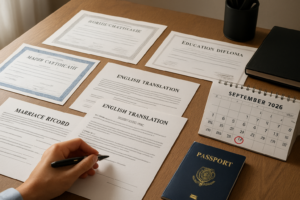
For Diversity Visa selectees, September 2026 is not the time to guess, delay, or submit incomplete paperwork. The fiscal year deadline of September 30 is final, and once it passes, unused visa eligibility generally disappears. That is why DV lottery document translation becomes a critical step for winners who must present clear, complete, and professionally prepared records for consular processing or adjustment-related review.
If your civil or educational documents are not in English, you may need certified translations so the reviewing officer can understand exactly what your records say. This applies to common documents such as birth certificates, marriage certificates, police certificates, and school records. Even when a case is otherwise strong, poor translations, missing pages, inconsistent names, or informal summaries can create delays at the worst possible moment.
This guide explains what winners typically need, how DV lottery document translation works, which records deserve special attention, and how to prepare before the September 30, 2026 deadline. If you are searching for a reliable translation provider, this is the stage where accuracy and speed both matter.
What the September 30 Deadline Means for DV Winners
The Diversity Visa program runs on a strict fiscal-year calendar. Selectees must complete all required processing while visas are still available and before the end-of-year deadline. In practical terms, that means your interview, document readiness, and eligibility must align in time. Waiting until late September to start gathering records is risky, especially when official copies and translations are involved.
Many winners underestimate how long it takes to obtain civil documents from local authorities, request police certificates from current or former countries of residence, or replace old school records. Add translation turnaround time, quality review, and possible corrections, and the timeline can tighten quickly.
That is why early DV lottery document translation planning is a smart legal and practical move. It helps you:
- Reduce the chance of interview delays
- Avoid confusion caused by misspelled names or dates
- Present a professional, complete file
- Respond faster if the embassy or attorney requests updated records
- Protect your eligibility before September 30, 2026
Do DV Lottery Documents Need Translation?
In many immigration contexts, documents not written in English must be accompanied by a full English translation and a certification from the translator stating that the translation is complete and accurate and that the translator is competent to translate. Embassy-specific practices can vary, and local-language exceptions may sometimes apply depending on the post, but English translations remain the safest and most widely accepted standard for international immigration processing.
For that reason, most winners should assume that DV lottery document translation is necessary whenever a required record is in another language. A proper translation is not just a summary or explanation. It should be a faithful rendering of the full document, including stamps, handwritten notes when legible, seals, marginal remarks, and official annotations where relevant.
If you are unsure whether a specific document requires translation, it is wise to verify the current instructions from the U.S. Department of State, your assigned embassy or consulate, or a qualified immigration professional. Still, as a practical matter, having certified English translations ready can prevent last-minute problems.
Birth Certificate Translation for DV Lottery Cases
Your birth certificate is one of the most important identity documents in a DV case. It helps establish your full legal name, date of birth, place of birth, and parentage. Any mismatch between your birth certificate and your passport, DS-260 information, or other civil records can trigger questions.
What a birth certificate translation should include
- Your full name exactly as shown on the original
- Date and place of birth
- Names of parents
- Registration number and issuance details
- Any amendments, notes, or late-registration remarks
- Official seals, stamps, and signatures when visible
For DV lottery document translation, birth certificates often require extra care because naming conventions differ across countries. Some records list family names first, some omit middle names, and some use patronymic or matronymic forms. A professional translator should preserve the original meaning while keeping the translation clear and consistent with your other immigration documents.
If your birth certificate was issued recently to replace an older version, submit the official current copy and have that version translated. If there are discrepancies, address them early rather than hoping they will be ignored at interview.
Marriage Record Translation: Proving Current and Prior Marital History
If you are married, your marriage certificate is essential. If you were previously married, divorce decrees, annulment records, or death certificates for former spouses may also be required. These documents help establish family eligibility and confirm that all relationships listed in your application are legally supported.
Common marriage-related documents that may need translation
- Marriage certificates
- Divorce judgments
- Annulment orders
- Death certificates of former spouses
- Name-change records related to marriage
In DV lottery document translation, marriage documents deserve close review because family-based eligibility issues can become serious quickly. If your spouse will immigrate with you, names, dates, and places must match across passports, civil records, and the DS-260. If a prior marriage ended, the translated termination document should clearly show the legal basis and effective date of the termination.
A common mistake is translating only the front page of a court record while leaving out the signature page, filing stamp, or final order language. Immigration officers often need the complete legal document, not just a partial excerpt. Certified, complete translation is the safer approach.
Police Certificate Translation: A Frequent Source of Delay
Police certificates can be among the most time-sensitive records in a DV case. Depending on your age and residence history, you may need police certificates from your current country of residence and from other countries where you lived for a qualifying period. These documents can take time to obtain, and some expire for practical purposes if they become outdated before interview.
Why police certificate translation matters
Police records often contain legal terminology, abbreviations, administrative references, and handwritten entries. A poor translation can create uncertainty about whether the certificate is clear, pending, limited, or disqualifying. Because admissibility issues are serious, police certificate translations should be precise and easy to read.
- Translate all text, including remarks and issuance notes
- Include official reference numbers and dates
- Preserve wording related to criminal history or no-record findings
- Translate stamps and seals where possible
When arranging DV lottery document translation for police certificates, ask the provider whether they have experience with legal and immigration terminology. Accuracy matters more than literal word-for-word awkwardness. The translation should be faithful but also understandable to a U.S. reviewing officer.
Education Document Translation for DV Eligibility
The Diversity Visa program has education or work experience requirements, and many winners rely on school records to demonstrate eligibility. That makes educational document translation especially important for principal applicants.
Education records that may need translation
- Diplomas
- Graduation certificates
- Secondary school transcripts
- Examination records
- Vocational certificates where relevant
For DV lottery document translation, the goal is not to rewrite the education system of your country into an American equivalent. Instead, the translation should clearly state what the original document says: institution name, dates of attendance, course or program, completion status, grades if shown, and award title. If abbreviations or ministry references appear, they should be translated accurately.
Because education eligibility can be scrutinized, avoid informal translations done by friends or family members. A professional translation service can provide a cleaner, certified document package that is easier to present at interview or to legal counsel.
What “Certified Translation” Usually Means
In immigration practice, a certified translation generally includes the full translated text plus a signed statement from the translator or translation company confirming that the translation is complete and accurate and that the translator is competent in both languages. This certification is not the same as notarization, though some providers offer notarized options if requested.
When ordering DV lottery document translation, look for these features:
- Complete translation of the full document
- Certification statement included
- Translator or agency identification
- Consistent formatting that mirrors the original where practical
- Delivery in PDF format suitable for printing and submission
- Option for rush turnaround if your interview is near
Be cautious with ultra-cheap services that rely heavily on unedited machine translation. Immigration documents contain names, dates, legal terms, and official phrases that require human review.
How to Prepare Your DV Lottery Document Translation Package
A well-organized package saves time and reduces stress. Before placing an order, gather clean scans or photos of each document. Every corner should be visible, and text should be readable. If the original has front and back content, include both sides.
Step-by-step checklist
- List every civil and education document required for your case.
- Obtain official copies if your originals are damaged or outdated.
- Check names, dates, and document numbers for consistency.
- Scan each document clearly in color whenever possible.
- Order certified English translations from a professional provider.
- Review the completed translations for spelling and factual accuracy.
- Keep digital and printed copies ready for interview or attorney review.
This process makes DV lottery document translation more efficient and lowers the chance of emergency corrections later in September.
Common Mistakes Winners Should Avoid
Even strong DV cases can run into preventable documentation problems. The most common issues include:
- Submitting partial translations instead of full translations
- Using low-quality scans that hide stamps or handwritten notes
- Waiting until the last week of September to order translations
- Ignoring discrepancies in spellings, dates, or place names
- Assuming every embassy will accept non-English originals without translation
- Using uncertified or casual translations from acquaintances
Because the deadline is unforgiving, these errors can be expensive. Professional DV lottery document translation is often a small cost compared with the value of preserving your immigration opportunity.
How to Choose a Translation Service for DV Lottery Documents
If you are comparing providers, look beyond price alone. Immigration translations should be fast, accurate, and properly certified. A good provider will understand legal formatting, maintain confidentiality, and respond quickly if a correction is needed.
Questions to ask before ordering
- Do you provide certified translations for U.S. immigration use?
- Can you translate birth, marriage, police, and education documents?
- What is your standard and rush turnaround time?
- Will the certification statement be included automatically?
- How do you handle unclear scans or handwritten text?
- Do you offer revisions if a name formatting issue appears?
For high-intent users searching for DV lottery document translation, the best service is one that combines speed with document-level accuracy. In late September, turnaround time can matter almost as much as quality, so choose a provider with proven immigration experience.
Final Thoughts: Act Before the September 30, 2026 Deadline
If you are a DV winner, do not leave translations for the final days of the fiscal year. Birth certificates, marriage records, police certificates, and education documents all play a direct role in showing that you are eligible and documentarily ready. A missing or poorly translated record can create delays when there is no time left to fix them.
The smartest approach is to gather your records now, verify what each document says, and order certified translations as early as possible. Reliable DV lottery document translation helps present your case clearly, reduces risk, and supports a smoother path to your visa interview before September 30, 2026.
If you need fast, professional help, now is the time to contact a qualified translation provider and get your documents ready while there is still time to act.