
Certified Portuguese Translation for Immigration and Education Credentials
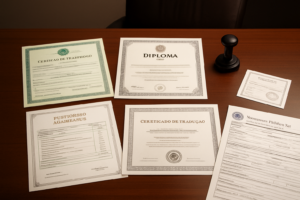
If you are submitting documents in the United States for immigration, school admission, credential evaluation, court use, or notarized and apostille-related purposes, accuracy matters. A certified Portuguese translation is often required when your original records are in Portuguese and the receiving institution needs a complete English version accompanied by a signed certification statement.
This is especially important for applicants from Brazil and Portugal. Birth certificates, marriage records, diplomas, transcripts, police records, and court documents often contain formatting, terminology, stamps, annotations, and registry details that must be translated carefully. A simple bilingual summary is usually not enough. In most cases, the receiving authority expects a full, faithful, and properly certified translation.
In this guide, you will learn how a certified Portuguese translation works, which documents commonly require certification, how Brazilian and Portuguese records should be translated for U.S. use, and what mistakes can cause delays in immigration filings, academic evaluations, and legal submissions.
What Is a Certified Portuguese Translation?
A certified Portuguese translation is a complete translation of a document from Portuguese into English, accompanied by a signed statement from the translator or translation company attesting that the translation is accurate and complete to the best of their knowledge and ability. In the U.S., certification usually refers to the translator’s declaration of accuracy, not government licensing.
For many purposes, the certification statement includes:
- The translator’s or company’s name
- A statement confirming fluency or competence in Portuguese and English
- A declaration that the translation is complete and accurate
- The date of certification
- A signature
For immigration matters, U.S. agencies such as USCIS generally require any foreign-language document to be submitted with a full English translation and a certification of accuracy. Schools, universities, evaluation agencies, courts, and attorneys may have similar standards. That is why ordering a certified Portuguese translation from a professional service is often the safest option.
When You Need a Certified Portuguese Translation in the U.S.
Users searching for this service are usually preparing official filings where incomplete or informal translations can lead to rejection, requests for evidence, or processing delays. Common use cases include:
- USCIS immigration petitions and supporting evidence
- Visa applications and consular processing
- Green card and naturalization cases
- Academic credential evaluations for schools and licensing boards
- University admissions and transfer credit reviews
- Family court, probate, and civil litigation
- Notarized or apostille document packages
- Employment verification and professional licensing
If your document is in Portuguese and the receiving organization operates in English, a certified Portuguese translation may be required even if you personally speak both languages. Many institutions will not accept self-translations or translations from family members because they want a neutral, formal certification.
Documents Commonly Translated from Brazilian and European Portuguese
Brazilian and Portuguese records can vary in wording, civil registry structure, abbreviations, and educational terminology. A qualified translator should understand these differences and preserve the meaning of the original document without rewriting it.
Vital Records
- Birth certificates
- Marriage certificates
- Death certificates
- Divorce decrees
- Name change records
- Family registry documents
Education Credentials
- Diplomas
- Academic transcripts
- Degree certificates
- Enrollment confirmations
- Course descriptions
- Secondary school records
Legal and Government Documents
- Police clearance certificates
- Court judgments
- Power of attorney documents
- Affidavits and sworn declarations
- Notarial acts
- Apostilled records
Each of these may require a certified Portuguese translation that includes seals, handwritten notes, marginal entries, and official annotations. Omitting these elements can create problems, especially in immigration and legal contexts.
How to Translate Brazilian and Portuguese Birth Certificates Correctly
Birth certificates are among the most frequently requested documents for immigration, passports, school registration, and identity verification. However, not all birth certificates look the same. Brazilian civil records often include registry office details, book and page references, CPF-related notes, annotations, and later amendments. Portuguese civil records may contain conservatória references, registration codes, and formal legal phrasing.
To translate these correctly, the translator should:
- Translate the entire document, not just the child’s name, date of birth, and parents’ names.
- Preserve registry information such as book, page, term number, office location, and official issue dates.
- Include annotations and marginal notes, which may reflect marriage, divorce, legitimation, adoption, or corrections.
- Reproduce names exactly as written, including accents, compound surnames, and ordering.
- Retain formatting logic so the English version clearly mirrors the source document.
A proper certified Portuguese translation of a birth certificate should not paraphrase legal content or simplify official language. For example, if the source contains a note about a later marriage or an amendment to the registry entry, that information should appear in the translation. USCIS, courts, and state agencies may consider such notes material to the case.
How to Translate Diplomas and Academic Transcripts Correctly
Education credentials require a different level of care because they are often reviewed by admissions offices, credential evaluation agencies, state licensing boards, and employers. A diploma may seem straightforward, but transcripts can be complex and full of institutional terminology, grading scales, abbreviations, and course titles.
Best Practices for Diplomas
When preparing a certified Portuguese translation of a diploma, the translator should preserve the original degree title as faithfully as possible while rendering it into natural English. The name of the university, date of conferral, signatures, seals, and registration references should also be included.
It is important not to “upgrade” or reinterpret the degree. The translator should translate the credential, not evaluate its U.S. equivalency. For instance, determining whether a foreign degree is equivalent to a U.S. bachelor’s or master’s degree is the job of a credential evaluator, not the translator.
Best Practices for Transcripts
Transcripts often contain:
- Course names
- Credit hours or workload
- Grades or marks
- Attendance information
- Academic periods or semesters
- Program completion status
- Institutional stamps and signatures
A high-quality certified Portuguese translation should translate course titles consistently and clearly. It should also preserve the grading information as presented, without converting grades into U.S. GPA format unless specifically requested as part of a separate evaluation process. If the transcript includes legends, grading scales, or explanatory notes, those should be translated as well.
For academic evaluations, accuracy in educational terminology is critical. Terms used in Brazil may differ from those used in Portugal, and both may differ from U.S. academic language. An experienced translator understands how to convey meaning clearly without altering the substance of the record.
Certified Translation vs. Notarization vs. Apostille
These terms are often confused, but they are not the same.
Certified Translation
This refers to the translator’s signed statement that the English translation is accurate and complete. This is what many U.S. agencies require when reviewing foreign-language documents.
Notarization
Notarization generally means a notary public verifies the identity of the person signing a document. In the translation context, a notary may notarize the translator’s signature on the certification statement if requested. Not every agency requires this, but some courts, schools, or state offices may ask for it.
Apostille
An apostille authenticates the origin of a public document for use in another country under the Hague Apostille Convention. It does not certify the translation itself. If you need both an apostille and a translation, you may need a certified Portuguese translation of the underlying document and sometimes of the apostille page as well, depending on the recipient’s instructions.
Before ordering, confirm whether the receiving institution wants:
- A certified translation only
- A certified translation with notarization
- A translation of both the original document and the apostille
- Hard copies, digital copies, or both
Common Mistakes That Cause Rejections or Delays
Official document translation is not the place to cut corners. The following issues frequently create problems:
- Incomplete translation: leaving out stamps, seals, side notes, or back-page content
- Self-translation: rejected by many institutions due to conflict concerns
- Machine-only translation: often inaccurate for legal and academic terminology
- Name inconsistency: mismatched spellings across passport, birth certificate, diploma, and transcript
- Formatting errors: making the translation too hard to compare with the original
- No certification statement: causing the document to fail formal submission requirements
Choosing a professional certified Portuguese translation service can help you avoid these issues and reduce the risk of resubmission.
How to Order a Certified Portuguese Translation
If you need to submit documents quickly, the ordering process should be simple and secure. Most professional services follow these steps:
- Upload clear scans or photos of your Portuguese documents.
- Specify the purpose, such as USCIS, university admission, credential evaluation, court filing, or apostille use.
- Confirm language direction, usually Portuguese to English.
- Request certification and ask whether notarization is also needed.
- Review delivery options, including PDF, mailed hard copy, or expedited service.
When ordering a certified Portuguese translation, mention whether the documents are from Brazil or Portugal. That detail can help ensure the translator uses the appropriate terminology and recognizes country-specific registry and education systems.
What to Look for in a Translation Provider
Not all providers handle official documents with the same level of care. For immigration and education credentials, look for a service that offers:
- Experience with Portuguese civil and academic records
- Certification accepted for U.S. immigration and academic use
- Attention to names, seals, annotations, and formatting
- Fast turnaround options for urgent filings
- Clear pricing and confidentiality protections
- Responsiveness to institution-specific requirements
A reliable provider should understand that a birth certificate for USCIS is not the same as a transcript for a credential evaluator. The best certified Portuguese translation services tailor the translation package to the actual use case.
Final Thoughts: Get Your Portuguese Documents Translated Correctly the First Time
Whether you are filing an immigration case, applying to a U.S. school, seeking a professional license, or preparing notarized and apostille-related records, precision is essential. Brazilian and Portuguese documents often contain legal and institutional details that must be translated fully and accurately. A professional certified Portuguese translation helps ensure your birth certificates, diplomas, and transcripts are accepted without avoidable delays.
If your deadline matters, do not rely on informal translations or generic software output. Order a certified Portuguese translation from a qualified provider who understands immigration standards, academic credential terminology, and official document formatting. Getting it right the first time can save time, money, and unnecessary stress.
When you are ready to submit your records in the U.S., a trusted certified Portuguese translation service can help you move forward with confidence.