
Navigating Interpreting Modes and Equipment Rental: A Guide for Successful Multilingual Events
Organizing a multilingual conference or event involves making several critical decisions regarding communication flow. Choosing the right interpretation style and renting the correct supporting hardware are essential steps to ensure your audience receives your message accurately and seamlessly.
1. Choosing the Right Interpretation Mode
Consecutive Interpreting: Ideal for Single-Language Groups
When your audience speaks a single foreign language and the speaker is presenting in English, consecutive interpreting is often the most practical choice. In this mode, the speaker delivers a few sentences, pauses, and allows the interpreter to translate the message before moving forward.
-
Advantage: It offers incredibly high accuracy because the linguist has time to fully process the text and take detailed notes.
-
Disadvantage: It takes significantly more time, effectively doubling the duration of the presentation.
Simultaneous Interpreting: Best for Multi-Language Demands
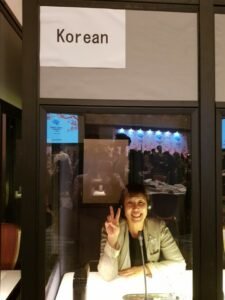
If your audience consists of two or more distinct language groups—such as English speakers alongside groups speaking Spanish, Tagalog, Chinese, Korean, or Armenian—simultaneous interpreting becomes necessary. The translation is delivered in real-time, allowing the event to proceed without pauses or interruptions.
2. Managing Interpreter Fatigue and Staffing Requirements
Simultaneous interpretation is an intense, high-pressure mental activity. Because of the cognitive load required to listen, translate, and speak concurrently, an individual interpreter’s accuracy typically begins to decline after 20 to 30 minutes.
To maintain high standards of communication, keep the following staffing guidelines in mind:
-
Events Over 1 Hour: It is vital to book at least two interpreters per language pair so they can rotate and rest every 20–30 minutes.
-
Remote Interpretation (Zoom/Teams): The exact same fatigue rules apply to virtual setups. While a single interpreter can technically push through a solo 1-hour assignment, they must be compensated at a premium of at least 1.5 times their regular rate to account for the extreme cognitive strain.
3. On-Site Hardware and Booth Options
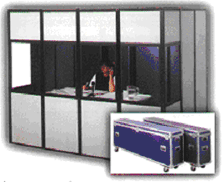
For major international conferences hosted at prominent venues and top hotels, standard room acoustics are rarely sufficient. You will need a dedicated interpretation hardware setup.
| Equipment Option | Best For | Soundproofing Capabilities | Technical Support Required |
| Full Soundproof Booth | Large international conferences, high-profile summits | Excellent — Completely isolates the interpreter’s voice from the audience and vice versa. | Requires a minimum of two technicians for setup, monitoring, and teardown. |
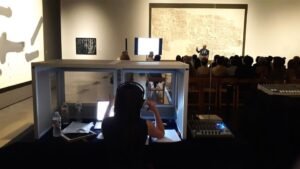
| Desktop Glass Booth | Limited budgets, smaller venue floor plans | Moderate — Keeps the interpreter’s voice from directly disrupting attendees nearby, though minor ambient noise may leak through. | Standard AV technical support recommended. |
| Portable Travel-Guide Systems | Ultra-tight budgets, walking tours, breakout sessions | Low — Background noise and distractions are common, requiring the audience to stay highly attentive. | Simple plug-and-play setup; rarely requires a dedicated on-site engineer. |
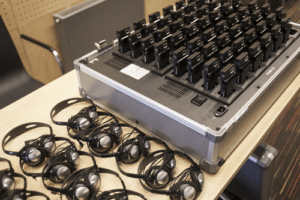
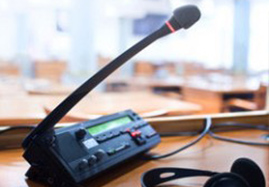
Technical Note: Regardless of the booth style you select, the entire system relies on a central mixer and console. The interpreter’s headset must be directly patched into the speaker’s microphone feed so they can monitor the audio with absolute clarity. The translated audio is then broadcast via a transmitter to the wireless receivers worn by the audience.
4. The Post-COVID Shift: Mastering Remote Simultaneous Interpretation (RSI)
Since the COVID-19 pandemic, remote simultaneous interpretation via platforms like Zoom has seen widespread adoption. Zoom features a native, paid interpretation module that allows hosts to establish specific audio channels. Attendees simply click a globe icon on their screen interface to choose and listen to their preferred language channel in real time.
However, executing this smoothly requires specialized technical oversight:
-
The Hosting Limitation: Zoom’s architecture dictates that only the paying host account holds the permission settings required to assign interpretation toggles and manage live language routing.
-
The Need for a Dedicated Engineer: Many event hosts mistakenly assume their translation agency can log in and fix configuration issues remotely on the fly. Because of Zoom’s structural restrictions, organizations must employ a designated technical engineer on their side who understands platform permissions to ensure seamless audio switching and prevent live execution errors.
Partner with a Trusted Provider
For over two decades, L.A. Translation and Interpretation, Inc. has provided dependable simultaneous interpreting services and high-quality equipment rentals to government agencies, multinational corporations, hospitals, and universities. Whether you need a full on-site booth installation with dedicated technicians or a streamlined remote Zoom configuration, we deliver reliable, expert solutions tailored to your event’s budget and scale.