公認翻訳(証明付き翻訳)の完全ガイド:USCIS、郡政府、および法的機関における手続き


公認翻訳(証明付き翻訳)の完全ガイド:USCIS、郡政府、および法的機関における手続き

移民局、裁判手続き、国際遺産相続などの複雑な行政手続きを進めるには、絶対的な正確性が求められます。提出する翻訳の種類を間違えるといった、たった一つの事務的なミスが、即座の却下、多大な費用の発生を伴う遅延、または審査の保留(ステータス延期)につながる可能性があります。

裁判所、USCIS(米国市民権・移民局)、大学、郡の記録局、大使館、病院などから「公認翻訳(証明付き翻訳)」の提出を求められた際、まず最初に行うべきステップは、相手方が具体的にどのような証明(Certification)を求めているかを正確に確認することです。 機関によって、その基準は大きく異なります。この総合ガイドでは、書類が一発で受理されるよう、地方、連邦、および国際的な管轄区域における厳格な基準について解説します。


1. 連邦政府への提出:USCISの翻訳要件

米国市民権・移民局(USCIS)において、外国語書類の取り扱いを規定する法的枠組みは、連邦法(8 CFR 103.2(b)(3))によって厳格に法制化されています。

連邦基準

この規定では、USCISに提出する外国語の書類には、完全かつ不足のない英文翻訳を添付しなければならないと定めています。

  • 要約の禁止: 翻訳者が文章を要約することは明確に禁じられています。単語一つひとつ、脚注、欄外の書き込み(余白のメモ)に至るまですべてを網羅しなければなりません。

  • スタンプと印章: 政府のスタンプ、肉筆の署名、エンボス加工(浮き出し)や薄い印章は、法的証拠となります。これらはすべて翻訳される必要があり、読み取れない場合はその旨を明記(例:[内務省の公印] など)しなければなりません。

  • 利益相反: ご自身がその言語にどれだけ堪能であっても、自分の書類(出生証明書や婚姻証明書など)を自分で翻訳することはできません。 これは直接的な利益相反とみなされ、自動的に却下される原因となります。

翻訳証明書(Certificate of Accuracy)

USCISにおいて法的な効力を持つためには、翻訳に翻訳者による署名入りの声明文が含まれており、かつ以下の4つの必須要素が記載されている必要があります。

  1. 翻訳者が原言語から英語へ翻訳する能力(資格)を有していることの宣言。

  2. 翻訳が完全かつ正確であることの証明。

  3. 翻訳者の活字体氏名、署名、および現在の連絡先。

  4. 作成(署名)年月日。

💡 プロのアドバイス: USCISは、L.A. Translation and Interpretation, Inc. のような確立された実績を持つ機関が発行した公認翻訳を日常的に受け入れ、信頼しています。信頼できる専門機関を選ぶことで、デジタルOCR(光学式文字認識)システムを用いた現代の機関による厳格な審査プロセスからも、あなたの申請書類を守ることができます。


2. 州および司法機関:カリフォルニア州の裁判所

カリフォルニア州の裁判所で外国語の書類を証拠として提出する場合、その基準は連邦政府の単純な「証明」から、州法が定める専門的な法的資格へと変化します。

カリフォルニア州の規則において、外国語書類を正式な証拠として採用するためには、裁判所公認通訳人(Court-Certified Interpreter)、または米国翻訳者協会(ATA)公認翻訳者(ATA-Certified Translator)によって翻訳されている必要があります。

                       [ 外国語の書類 ]
                              │
             ┌────────────────┴────────────────┐
             ▼                                 ▼
   [ 裁判所公認通訳人 ]               [ ATA公認翻訳者 ]
             │                                 │
             └────────────────┬────────────────┘
                              ▼
                       [ 採用可能な裁判用証拠 ]

大半の裁判所公認通訳人は、リアルタイムで迅速に進行する法廷での「口頭通訳」業務で手一杯であるため、彼らに書面の翻訳を依頼することは非常に非効率的です。その代わりに、カリフォルニア州の裁判所で証拠提出用として広く受け入れられているATA公認翻訳を確保する方が、はるかに迅速であり、かつ規則にも完全に準拠します。

「エキゾチック(希少)言語」の例外

正式な裁判所公認試験やATAの公認試験が存在しない、希少な言語や話者数の少ない言語については、カリフォルニア州の裁判所も柔軟な対応をとっています。このような特定の状況においては、L.A. Translation and Interpretation, Inc. のような、認知された専門翻訳機関によって公式に証明された翻訳が裁判所に受理されます。


3. 地方自治体:郡政府での外国の死亡証明書の登記

地方自治体における最も複雑な法的シナリオの一つが、米国市民が外国で亡くなり、遺族が現地(カリフォルニア)の資産を相続するために、郡(County)に死亡の事実を登記する必要があるケースです。

郡の記録局(County Recorder)は、標準的な翻訳フォーマットを受け付けません。彼らは以下のような独自の極めて厳格な基準を課しています。

  • 二重の義務: 書類は、裁判所公認通訳人またはATA公認翻訳者によって翻訳されていなければなりません。

  • 郡指定のフォーム: 郡のオフィスで直接、追加の証明手続きを行うステップが必要です。(郡指定の宣言書フォームへの記入)

  • 宣言書の相違: 郡のオフィスは、裁判所通訳人が使用する一般的な標準声明文とは根本的に異なる、極めて特定の「翻訳宣言書(Certificate of Translation)」フォームを要求します。彼らが指定する正確な自治体テンプレートを使用しない場合、登記は即座に拒否されます。


4. 教育機関:海外の学位記と成績証明書

海外で取得した資格や学位をもって米国の大学や専門職の免許委員会に申請する場合、単に翻訳を提出するだけでは不十分なケースがほとんどです。

多くの高等教育機関では、以下のような多段階の確認プロセスを設けています。

  1. 公認翻訳: 学位記(ディプロマ)と全期間の成績証明書を、専門の翻訳機関で翻訳・証明する必要があります。

  2. 学位・単位査定(Credential Evaluation): その公認翻訳を、承認された第三者査定機関(NACESやAICEの加盟機関など)に提出します。これらの機関が、履修科目や取得単位数を評価し、米国の教育システムにおける正確な相当価値を判定します。

※大学側が、翻訳をまず大学に送ることを希望しているのか、それとも査定機関に直接送ることを求めているのかを、必ず事前に確認してください。


5. 国際的な場面:外国の大使館・領事館

米国の書類を外国の大使館に提出する際は、国際的な主権法に対応する必要があります。ヨーロッパやラテンアメリカの国々を対象とする場合、米国で一般的な公証(Notarized)付きの標準的な翻訳は、ほぼ例外なく却下されます。

スペイン、フランス、コロンビアなどの国々では、法的な拘束力を持つ、非常に厳格に体系化された翻訳枠組みが要求されます。

国名 必要とされる枠組み システムの要件
スペイン

Traducción Jurada


(宣誓翻訳)

スペイン外務省(MAEC)に公式に任命・登録された「宣誓翻訳士(Traductor Jurado)」が作成しなければなりません。スペイン当局に登録された厳格な署名およびスタンプのプロトコルが適用されます。
フランス

Traduction Assermentée


(公認翻訳)

司法専門家として登録され、フランスの控訴裁判所(Cour d’appel)で正式な宣誓を行った「公認翻訳士(Traducteur Assermenté)」が執行しなければなりません。
コロンビア

Traducción Oficial


(公式翻訳)

コロンビア国立大学での技能試験に合格し、外務省にその印章を登録している公認公訳士(Traductor Oficial)が作成しなければなりません。

⚠️ 重要な警告: 規則は領事館の所在地(都市)によって異なる場合があります。米国国内にある一部の領事館では、国内の翻訳にアポスティーユ(Apostille)を束ねたものを暫定的に受け入れるケースもありますが、他方では海外の宣誓翻訳を厳格に義務付けているケースもあります。サービスを注文する前に、必ず提出先の大使館または領事館に正確な要件を調査してください。

在米中国大使館における手続きの複雑さ

米国の書類を中国大使館を通じて使用するために証明・合法化(認証)する手続きは、悪名高いほど複雑で何段階ものプロセスを要します。一般的には以下が必要です。

  1. 米国の原公文書に対する現地の公証。

  2. 書類が発行された州の国務長官(Secretary of State)による認証。

  3. 誤字脱字やレイアウトの不一致を一切許さない、厳格な認証フォーマット。

中国大使館は極めて厳密な行政プロトコルを適用しているため、軽微な事務的ミスによる再訪を何度も繰り返したくない場合は、最新の正確な申請詳細を事前に確認することが不可欠です。


成功のための要約チェックリスト

  • [ ] 最終提出先の特定: 提出先は地方(郡政府)、州(裁判所)、連邦(USCIS)、または国際(大使館)のいずれですか?

  • [ ] 書面による基準の確認: 翻訳者を雇う前に、提出先が定めている具体的な翻訳ポリシーを要求・確認しましたか?

  • [ ] 資格の確認: 翻訳者が、要求されている正確な肩書(ATA、裁判所公認、Traductor Jurado、Traducteur Assermentéなど)を保持しているか確認しましたか?

  • [ ] 完全性のチェック: 最終稿において、印章、スタンプ、あるいは欄外の文字などが一つも省略されずに翻訳されているか確認しましたか?


L.A. Translation & Interpretation, Inc. は、お客様が必要とする正確な公認翻訳(証明付き翻訳)を提供する翻訳会社です。不必要なストレスや非効率な作業を避け、専門家による確かなサービスをご利用ください。

The Essential Guide to Renting Simultaneous Interpreting Equipment

Navigating the Global Stage: The Essential Guide to Renting Simultaneous Interpreting Equipment in Los Angeles

Los Angeles is far more than just the entertainment capital of the world; it is a sprawling, dynamic global crossroads. As a truly cosmopolitan city, the linguistic diversity found within its borders is staggering. According to recent demographic data, roughly 56.8% of the population speaks a foreign language at home, reflecting a rich tapestry of cultures from every corner of the earth. Furthermore, approximately 39.7% of the city’s residents consist of immigrants who have relocated to Southern California, weaving their native traditions and languages into the very fabric of the region.

Because of this unique demographic profile, communication in Los Angeles regularly transcends English. In 2025 alone, thousands of international conferences and meetings took place across the city, drawing global leaders, innovative entrepreneurs, and academic researchers. It is the ultimate dream of many international businesses to introduce their cutting-edge products and services to the massive, diverse audience in Los Angeles. However, executing a successful event in such a multilingual environment requires more than just a great venue and compelling slides—it requires bridging the language gap seamlessly.

When an event features English-speaking presenters alongside a sizeable number of participants who are not fluent in English and need interpreting, simultaneous interpreting becomes an absolute necessity. Unlike traditional translation, which deals with written text, or consecutive interpreting, where speakers pause to let the linguist talk, simultaneous interpreting happens in real time. It allows information to flow continuously without interrupting the natural rhythm of the speaker.

To achieve this fluid exchange of ideas, highly specialized audio hardware must be deployed. For event planners, corporate executives, and community organizers alike, understanding the logistics of renting simultaneous interpreting equipment is the key to executing a flawless multilingual event.


The Landscape of Multilingual Events in Southern California

The demand for high-end language services spans a wide array of sectors. On any given day in Southern California, corporate workshops, international trade summits, governmental forums, and educational seminars are actively running. Each of these events serves a different purpose, yet they all share a common requirement: clear, instantaneous cross-linguistic communication.

Academic and Corporate Sectors

Major educational institutions frequently host global symposiums that require highly specialized linguistic support. For example, prominent language service providers like L.A. Translation & Interpretation, Inc. have provided elite interpreters and advanced equipment rentals to tens of high-profile workshops and conferences held by elite universities, including the University of Southern California (USC) and the University of California, Los Angeles (UCLA). Whether it is a medical research breakthrough being shared at a university forum or a multinational tech company pitching its latest software to foreign investors, simultaneous interpreting equipment keeps the entire room aligned.

Entertainment and Film industries also need simultaneous interpreting when engaging international talents.  Multinational Automobile companies and cosmetics companies, for example, conduct consumer research such as focus groups before launching their products in the U.S. Market and need accurate, high quality translators and equipment.

Community and Civic Engagement

Language access is not reserved solely for Fortune 500 corporate boardrooms or sprawling convention centers. It plays a vital role in local civic life and family milestones:

  • School Commencements: Graduation ceremonies are a prime example of where simultaneous interpreting is essential. When proud parents and grandparents travel from foreign countries to watch their loved ones walk across the stage, providing real-time interpretation in their native language ensures they can fully experience the speeches and celebrations.

  • Homeowners Association (HOA) Meetings: In linguistically diverse neighborhoods throughout Southern California, HOAs frequently need interpreters for important community meetings. When crucial decisions regarding property regulations, budgets, or local developments are on the line, every resident deserves a voice, regardless of their English proficiency.

  • Weddings, Parties and Funerals: As true love transcends borders, there are many international weddings in Los Angeles which require simultaneous interpreting.  It is considerate to provide interpreter for non-English speaking persons at the funeral, so that they can share the memories of the deceased.
  • Local government hearings: County, City and State governments frequently hold hearings to aggregate public opinion and provide simultaneous interpreting
  • Church sermons and religious gatherings: Many churches in Los Angeles provide simultaneous interpreting for congregation with limited English fluency.

Decoding the Equipment: Transmitters, Receivers, and Headsets

Simultaneous interpreting relies on a sophisticated “closed-loop” wireless audio network. The process begins when the floor speaker talks into the main microphone. That audio feed is routed directly into the interpreter’s headset. As the interpreter listens to the English source, they instantly speak the target language (such as Spanish, Mandarin, Korean, or Armenian) into an isolated microphone. This translated audio signal is then broadcast through a transmitter to the audience.

When planning an equipment rental, the choice of transmission technology depends directly on the layout of your venue and the size of your crowd.

[ Floor Speaker ] ──(Main Audio)──> [ Interpreter Booth ]
                                              │
                                     (Translated Audio)
                                              │
                                              ▼
                                      [ Transmitter ]
                                              │
                                        (Radio/IR Wave)
                                              │
                                              ▼
                                    [ Audience Receivers ]

1. Large-Scale Stationary Transmitters

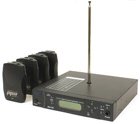
For sizeable events featuring more than 100 people, multi-channel stationary transmitters are utilized. These powerful units are connected directly to the venue’s main sound mixing board or the interpreters’ central control console. They plug into robust external antennas that blanket large banquet halls, hotel ballrooms, or auditorium spaces with a reliable audio signal, ensuring no dropouts occur even in a crowded room.

2. Portable Transmitters

For mobile settings or smaller gatherings of under 100 people, a portable transmitter is the ideal alternative. This compact, battery-powered device is typically worn on a lanyard or held by a tour guide or interpreter. It is incredibly effective for field workshops, factory tours, museum walkthroughs, or intimate breakouts where the group is constantly on the move.

3. Audience Receivers and Headsets

On the listening end, non-English speaking attendees are provided with lightweight, battery-operated wireless receivers paired with comfortable earphones or over-ear headsets. Attendees simply switch their individual receiver to the specific channel assigned to their language (e.g., Channel 1 for Spanish, Channel 2 for Mandarin) and adjust their volume. This allows them to listen to the speaker’s presentation simultaneously in their native language, maintaining identical pacing and emotional impact as the rest of the room.


The Role of Soundproof Booths in Simultaneous Interpreting

One of the most critical—yet frequently overlooked—components of an interpreting rental package is the acoustic containment system. Simultaneous interpreters must talk at the exact same time as the primary speaker. Without proper sound isolation, two major problems occur: the interpreter’s voice will distract the nearby audience members, and the ambient noise from the venue will leak into the interpreter’s microphone, muddying the translation feed.

To solve this, international conferences dictate strict guidelines regarding soundproofing. Depending on space constraints and budget realities, event planners can choose from a few standard options:

Full-Size Soundproof Booths

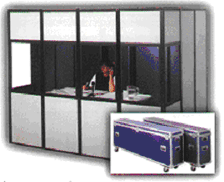
Most high-level international conferences and governmental summits require a full soundproof booth. These are walk-in structures designed to comfortably accommodate two or three interpreters for long shifts. They feature built-in ventilation fans, acoustic panels, and double-paned viewing windows so the linguists maintain a clear line of sight to the stage. These walls protect the interpreters from outside distractions while ensuring the surrounding audience won’t be bothered by the ongoing translation.

Desktop Glass Soundproof Booths

For smaller venues or intermediate groups of 100 people or less, a desktop glass soundproof booth can do a fantastic job. These are compact, three-sided or four-sided enclosures that sit on top of a standard banquet table. While they do not offer the complete acoustic isolation of a walk-in unit, they effectively block a significant amount of forward-facing sound. It is a highly practical solution that is exponentially better than having no booth at all.

Portable Travel Booths and Boothless Options

Some non-governmental organizations (NGOs) operating with small groups, such as a localized HOA meeting or a small neighborhood council, wouldn’t require a heavy, full-sized booth. In these intimate settings, the interpreter can utilize a highly lightweight, portable tabletop shield, or bypass the booth entirely by sitting in the back of the room with a portable transmitter, speaking in quiet whispers to minimize audio bleed.


Simultaneous vs. Consecutive Interpreting: Which Do You Need?

A common mistake when organizing a multilingual meeting is confusing simultaneous interpreting with consecutive interpreting. Renting an array of transmitters and headsets is only necessary if your audience layout warrants real-time transmission.

Feature Simultaneous Interpreting Consecutive Interpreting
Timing Real-time, continuous delivery. Step-by-step; speaker pauses for the interpreter.
Hardware Needed Transmitters, receivers, headsets, and booths. Standard microphone and PA system (if any).
Audience Profile Mixed crowd (some English speakers, some non-English). Uniform crowd (the entire audience speaks the same foreign language).
Event Duration Normal runtime; no extra time added. Doubles the required presentation time.

If the entire audience is a foreign-language-speaking group and there are no English speakers in attendance except the presenter, then consecutive interpreting is typically required. In this setup, the speaker delivers a few sentences in English, pauses, and the interpreter steps up to replicate those sentences in the target language. Because everyone in the room needs to hear the exact same translation sequentially, specialized wireless headsets and soundproof booths are completely unnecessary.


Partnering with an Experienced Industry Leader

Renting interpretation gear is not a simple DIY project. It requires meticulous audio engineering, precise frequency coordination to prevent wireless interference, and deep expertise in matching the right equipment to the specific venue dynamics.

When execution matters, turning to an established local institution is vital. L.A. Translation & Interpretation, Inc. has proudly provided top-tier interpreting services and professional equipment rentals for over 23 years, serving Southern California consistently since 2003. Their decades of hands-on experience ensure that your corporate summit, academic workshop, or community meeting receives the exact technical layout required for crystal-clear, uninterrupted communication.

By investing in the correct transmitter configurations, choosing appropriate acoustic booths, and aligning with seasoned professionals, your organization can break down language barriers and tap into the vibrant, cosmopolitan potential that makes Los Angeles a premier destination for global business.

Where Can I Find a Certified Korean Translator for Legal Documents?

Where Can I Find a Certified Korean Translator for Legal Documents?

Spanish Translator

Navigating California Court Requirements, the Dynamics of Check Interpreters, and Strategic Language Partner Selection in High-Stakes Litigation


In an increasingly interconnected global economy, legal proceedings frequently cross linguistic and cultural borders. Among these, legal disputes involving South Korean entities, contracts, and evidence have surged significantly over the last few decades. Whether dealing with a local civil dispute, an international contract disagreement, a complex immigration filing, or multi-billion-dollar patent litigation involving multinational tech giants, the accuracy of your translated documents is paramount.

A single mistranslated word or an ambiguous phrase can alter the interpretation of a contract, invalidate a key piece of evidence, or cause a judge to dismiss critical documentation. For attorneys, paralegals, and litigants, this reality prompts a fundamental, high-stakes question: Where can I find a certified Korean translator for legal documents whose work can withstand the absolute highest levels of judicial scrutiny?

To answer this question effectively, one must look closely at state-specific evidentiary requirements, the structural landscape of professional translation, the hidden ethical and operational battles that take place inside the courtroom, and the specialized agencies equipped to navigate these complexities.


1. The Legal Reality: California Court Requirements for Translations

When introducing foreign-language documents into a California court, the rules of evidence are strict and unforgiving. Under the California Rules of Court, any document written in a language other than English must be accompanied by an accurate, certified English translation. Bypassing this step or relying on an uncertified translator opens the door for opposing counsel to object to its admissibility, potentially gutting your evidentiary strategy.

In California, the gold standard for validating a document submission is utilizing an interpreter or translator who holds specific credentials recognized by judicial or professional governing bodies:

The Court-Certified Interpreter

A court-certified interpreter is an individual who has passed rigorous bilingual examinations administered by the Judicial Council of California. While their primary, day-to-day role involves real-time verbal interpretation inside the courtroom, their official state certification serves as an ultimate badge of linguistic competence and legal knowledge. Because they are officers of the court, their signed certifications carry significant weight with judges.

The ATA-Certified Translator

A practical hurdle arises when seeking court-certified interpreters for document translation: availability. Because the demand for live, spoken-word interpretation across California’s massive superior court system is ceaseless, most court-certified interpreters are fully booked, spending their days handling trials, depositions, and arraignments. They rarely have the time to sit down and translate lengthy, complex legal texts.

To resolve this bottleneck, California courts widely accept translations completed by ATA-certified translators (certified by the American Translators Association). Unlike interpreters, who specialize in instantaneous verbal communication, ATA-certified translators are strictly trained in the written word. They possess a deep mastery of legal terminology, syntax variations, and formatting standards. Utilizing an ATA-certified professional ensures your documents meet the court’s strict evidentiary thresholds while bypassing the scheduling conflicts of active courtroom interpreters.


2. Structural Security: Why Agency Screening Matters

Finding an independent translator via an online directory might seem straightforward, but in the legal arena, unverified sourcing represents an immense liability. True security comes from partnering with an established, specialized language service provider that implements strict quality-control protocols.

For legal professionals seeking peace of mind, a highly effective strategy is to utilize an authoritative, specialized firm such as L.A. Translation and Interpretation, Inc. Founded in 2003 and celebrating over 23 years of operation, the company’s structural advantage stems directly from its leadership. It is owned and managed by Dr. Junhui Joo, a highly respected State of California court-certified Korean interpreter.

[Original Legal Text] ➔ [Stage 1: Translation] ➔ [Stage 2: Proofreading] ➔ [Stage 3: Editing] ➔ [Certified Court-Ready Document]

Dr. Joo’s firsthand understanding of the strict demands of the judicial system has allowed her to rigorously screen, test, and cultivate a premier network of top-tier legal translators over more than two decades. A reliable legal translation cannot be a single-pass effort. To guarantee that a document is completely bulletproof before it reaches a judge’s desk, a firm must process all materials through a comprehensive three-stage quality control workflow:

  1. Translation: A native-speaking, legally trained translator creates the initial English rendering, carefully matching complex Korean legal terms (e.g., specific contractual obligations or corporate structures) to their exact American common law equivalents.

  2. Proofreading: A second independent linguist meticulously checks the translation against the original source text line-by-line, verifying that no numbers, dates, signatures, or clauses were omitted, and that the formatting mirrors the original document.

  3. Editing: A senior legal editor refines the syntax and tone, ensuring that the final document reads seamlessly in natural legal English while remaining completely faithful to the original legal intent.

This multi-tiered structural screening completely mitigates the risk of human error, protecting your case from devastating translation errors.


3. The Hidden Battleground: “Check Interpreters” and Document Disputes

Many individuals outside the legal field assume that translation is an exact science with only one correct answer. In reality, language is inherently subjective, and the courtroom frequently becomes a battleground over document translations.

In a standard trial involving foreign language evidence, each side may have its own linguistic experts. When one party introduces a translated document, the opposing party often employs a “check interpreter” or “monitor interpreter.” The check interpreter’s job is to sit at the counsel table, review the transcripts and documents being presented, and listen carefully to the official courtroom interpretation to catch any potential errors, omissions, or misalignments that could disadvantage their client.

                  +-----------------------------------+
                  |       Official Interpreter        |
                  | (Renders translation/testimony)  |
                  +-----------------------------------+
                                    ^
       Discreet Note                |
       (Per Ethics Code)            | Raises Objection
                                    | (In High-Stakes Litigation)
                  +-----------------------------------+
                  |          Check Interpreter        |
                  | (Monitors accuracy for opposition)|
                  +-----------------------------------+

When a check interpreter disagrees with a document translation already submitted into evidence, a major dispute can break out mid-trial. If the disagreement is severe, the legal proceedings may stall completely, forcing the judge to call a recess and bring in an independent, third-party neutral expert to determine which translation is legally and contextually accurate.

The Ethics of Disagreement

To prevent these linguistic disputes from turning into chaotic arguments that disrupt trials, the Professional Ethics for Court Interpreters (established by the Judicial Council) clearly define how a check interpreter must behave.

According to these ethical guidelines, if a check interpreter identifies an error made by the main interpreter or within an admitted document transcript, they are not supposed to stand up and shout an objection to the court. Instead, the ethical protocol dictates that the check interpreter must inform the main interpreter quietly and discretely, typically by sending a brief, written note through the bailiff or during a natural pause. This gives the main interpreter the professional opportunity to review the feedback, verify the context, and either make a quiet correction on the record or confidently stand by their original translation.

Because your opponent’s check interpreter will look for any leverage to pick your evidence apart, it is absolutely vital to secure an initial translator whose accuracy and credentials are unassailable. If you want to win a closely contested case, your translator’s work must be robust enough to easily withstand the scrutiny of an aggressive opposing expert.


4. High-Stakes Legal Wars: International Litigation and the “Samsung Effect”

The structural and ethical complexities of language services escalate dramatically when litigation moves from local courtrooms into the arena of major international corporate battles. A prime example of this is multi-district patent infringement lawsuits filed against massive South Korean conglomerates, such as Samsung, LG, or Hyundai.

In these high-stakes, multi-million-dollar intellectual property wars, the interpreter and translator issues become incredibly complicated. While domestic court interpreters are bound by the Judicial Council’s Code of Ethics—which mandates professional courtesy, mutual respect as colleagues, and limiting objections strictly to major, material errors—there is no universally binding international Code of Ethics.

The Strategy of Linguistic Attrition

When international litigations involve massive corporate stakes, check interpreters from South Korea can be extraordinarily aggressive and adversarial. Rather than following Western judicial decorum and raising discrete objections only when a material error occurs, these overseas check interpreters frequently adopt a deliberate strategy of attrition. They will aggressively object to almost every single line of interpretation or document translation rendered by the main interpreter.

They object to presentation styles, tone, regional vocal inflections, and completely valid synonyms, presenting that their specific choice of words which is in most cases absurd. In many instances, this behavior is so intense and relentless that it becomes clear their primary objective is not accuracy, but rather to disturb, frustrate, and actively delay the legal proceeding itself. Given that these large foreign entities are usually the defendants, slowing down a deposition or creating confusion in front of a jury is a highly effective defensive tactic.

Navigating Adversarial Dynamics

Surviving this environment requires immense psychological fortitude. The main interpreter must possess considerable mental strength, absolute composure, and profound confidence in their linguistic capabilities to consistently navigate unreasonable objections and a routinely offensive, rude, or condescending attitude from the defense’s check interpreters.

Compounding this difficulty is a common tactical error made by American trial attorneys. Because the U.S. attorney does not understand a word of the Korean language, they cannot tell who is right and who is wrong when an argument erupts. Hearing a constant stream of aggressive objections from the Korean defense team, the U.S. attorney frequently panics, blames their own interpreter, and mistakenly assumes she is doing a poor job.

[Aggressive Objections from Korean Team] ➔ [U.S. Attorney Panics] ➔ [Interpreter Constantly Swapped] ➔ [Case Continuity Breaks Down]

When an attorney repeatedly swaps out interpreters mid-deposition or mid-trial out of fear, the case’s continuity breaks down. The attorney is changing language experts completely blindly, without knowing the linguistic nuances or understanding who the superior professional actually is. This plays directly into the hands of the opposing defense team.

The most effective strategy to counter these aggressive tactics involves two clear steps:

  • The Tactical Flip: The U.S. team can strategically choose to let the defense’s hyper-aggressive check interpreter take over the primary role of interpreting. The main interpreter then shifts into the check-interpreter role. Because the overseas interpreters are often no better equipped (and are frequently less familiar with American courtroom rules) than the domestic main interpreter, the domestic interpreter can then easily monitor, verify, and check their work from a position of control.

  • Pre-Trial Attorney Briefing: Before any testimony or deposition begins, attorneys on both sides should be explicitly advised and ordered by the court or deposition officer to establish ground rules. Interpreters must be instructed to raise an objection only when the main interpretation is seriously and materially wrong, and never when it is simply a matter of a differing presentation style or a subjective choice of words.


5. Conclusion: Your Choice of Interpreter Can Decide the Case

In high-stakes litigation, even the absolute top Korean court interpreters and translators are human beings who can make mistakes under pressure. The higher the financial stakes or the legal consequences of a trial, the more rigorously you must screen the professionals handling your foreign language evidence.

It is no exaggeration to state that your choice of a certified Korean legal translator or courtroom interpreter can directly impact whether you win or lose your case. Walking into a deposition or a trial with an unverified, unscreened translator leaves you totally exposed to aggressive opposing experts, evidence exclusion, and procedural chaos.

To secure an unassailable legal advantage, you must rely on a proven, deeply experienced partner. Utilizing an elite organization like L.A. Translation and Interpretation, Inc.—with its 23-year track record of rigorous screening under the expert guidance of Dr. Junhui Joo—ensures that your legal documents are flawlessly prepared. Their top-tier certified professionals possess the linguistic precision and psychological resilience required to overcome aggressive opposing tactics, protect your evidence, and maintain peak performance when it matters most.


Summary Checklist for Legal Professionals Submitting Korean Documents

Requirement / Scenario Best Practice Strategy
California Superior Court Filing Must be translated and certified by a JCC Court-Certified Interpreter or an ATA-Certified Translator.
Court Interpreter Availability Use ATA-Certified Translators for documents, as court-certified interpreters are usually tied up with live verbal proceedings.
Preventing Counter-Expert Objections Ensure your translation provider utilizes a mandatory three-stage system (Translation, Proofreading, Editing).
Handling Opposing Check Interpreters Secure highly confident, screened specialists capable of handling stressful courtroom dynamics and maintaining focus.
Major Patent/International Lawsuits Establish clear pre-trial boundaries regarding valid linguistic objections versus stylistic preferences to prevent bad-faith delays.


Traducción de actas de nacimiento al español, notaría y apostilla: Su guía completa para la legalización de documentos

Traducción de actas de nacimiento al español, notaría y apostilla: Su guía completa para la legalización de documentos

Ya sea que esté buscando la doble nacionalidad en México, navegando por una herencia de bienes dejada por sus padres en El Salvador, o intentando registrar un evento vital —como un nacimiento, defunción, matrimonio o divorcio— en cualquier nación de habla hispana, rápidamente se enfrentará a una compleja red de burocracia legal.

Para que un documento civil estadounidense sea reconocido como legalmente vinculante por un gobierno extranjero, una simple traducción nunca es suficiente. Debe navegar por un proceso de legalización de varios pasos que incluye la traducción certificada, la notarización y la Apostilla.

El incumplimiento de tan solo uno de estos pasos puede provocar que su solicitud sea rechazada o aplazada por los consulados extranjeros y los registros civiles. Esta guía completa detalla las normas transfronterizas exactas y explica cómo asegurar sus documentos correctamente desde el primer intento.


El esquema transfronterizo: Por qué la traducción simple falla

Los documentos legales y civiles estadounidenses no tienen validez legal inherente fuera de los Estados Unidos. Para cerrar esta brecha jurisdiccional, los ministerios de relaciones exteriores y las embajadas confían en marcos de tratados internacionales para verificar su autenticidad.

Al presentar documentos en países de habla hispana, su papeleo debe someterse a una transformación precisa de tres etapas:

[ Acta original de EE. UU. ] ──> [ Traducción certificada ] ──> [ Notarización ] ──> [ Apostilla de la Secretaría de Estado ]

1. Traducción certificada

El primer paso es traducir todo el documento civil del inglés al español. Esta debe ser una traducción literal, línea por línea, que abarque cada sello, timbre, código de barras y nota marginal escrita a mano.

La traducción debe ir acompañada de un Certificado de Traducción formal (también conocido como Declaración de Exactitud). Esta declaración debe estar firmada por el traductor o un representante oficial de la agencia de traducción, declarando explícitamente su fluidez en ambos idiomas y jurando que el texto traducido es una representación completa y fiel del registro original.

2. Notarización

El Certificado de Traducción debe ser firmado en presencia física de un Notario Público autorizado. El notario ejecuta una declaración jurada o reconocimiento, sellando el documento con su sello oficial.

Distinción crucial: El notario no está notarizando la exactitud de la traducción ni verificando el contenido del acta de nacimiento. Está validando estrictamente la identidad del traductor que firmó el Certificado de Traducción. Este paso es obligatorio porque las oficinas gubernamentales no pueden emitir una Apostilla sin la firma de un notario verificado en sus archivos.

3. La Apostilla

El paso final y más crítico es adquirir la Apostilla. Firmado en 1961, el Convenio de la Apostilla de La Haya es un tratado internacional que agiliza la legalización de documentos para su uso en el extranjero. Debido a que los Estados Unidos y casi todas las naciones de habla hispana (incluidos México, El Salvador, Colombia, España y Argentina) son signatarios de este convenio, la Apostilla es el estándar de oro universal para la validación de documentos transfronterizos.

La Apostilla en sí es un certificado público numerado emitido directamente por la Secretaría de Estado (o la autoridad regional competente) donde se ejecutó el documento subyacente. Cuenta con un número de seguimiento, el sello del estado y la firma del Secretario de Estado, verificando oficialmente que el Notary Public que firmó su traducción posee una comisión legal válida y activa. Una vez adherida, el documento es legalmente incuestionable y debe ser aceptado por cualquier país miembro de La Haya.


Escenarios de la vida real: ¿Cuándo necesita este servicio?

El requisito de un paquete completo de traducción, notaría y Apostille generalmente se activa durante las transiciones legales transfronterizas importantes:

Búsqueda de la doble nacionalidad en México

Obtener la doble nacionalidad mexicana por ascendencia paterna (Doble Nacionalidad) requiere presentar su acta de nacimiento estadounidense ante el Consulado de México o un registro civil local en México. Exigen una traducción minuciosa al español y una Apostilla emitida por el estado para vincular legalmente su identidad estadounidense con su linaje ancestral mexicano.

Herencia de propiedades en El Salvador

Si sus padres poseían terrenos, cuentas bancarias o bienes raíces en El Salvador y usted necesita liquidar su patrimonio o reclamar una herencia, los tribunales y bancos salvadoreños exigen una prueba absoluta de su parentesco con el fallecido. Debe presentar su acta de nacimiento, junto con las actas de matrimonio o defunción correspondientes, completamente traducidas, notarizadas y autenticadas mediante una Apostilla para hacer valer sus derechos legales como heredero según el derecho civil salvadoreño.

Registro de eventos vitales en el extranjero

Si es un ciudadano estadounidense que se muda a un país de habla hispana por matrimonio, jubilación o empleo a largo plazo, debe registrar su estado civil actual ante las autoridades locales. Esto incluye la traducción y el apostillado de sentencias de divorcio de matrimonios anteriores, actas de matrimonio para visas conyugales o actas de defunción para entornos sucesorios internacionales.


El peligro de contratar a la agencia equivocada

Un error común y costoso que cometen muchos solicitantes es contratar plataformas de traducción en línea estándar y no verificadas o traductores independientes generales.

Los consulados y embajadas internacionales mantienen normas increíblemente rígidas. Algunos países exigen una redacción específica dentro del Certificado de Traducción, mientras que otros exigen que la traducción se adjunte al documento original en una disposición física específica. Si una agencia novata comete un error en el formato de la notarización, la Secretaría de Estado rechazará la solicitud de Apostilla, lo que le obligará a reiniciar todo el proceso desde el principio, costándole semanas de tiempo perdido y dinero en gastos de mensajería.

El poder de la consulta

Antes de solicitar una traducción certificada a cualquier agencia genérica, es de suma importancia consultar los sitios web oficiales del consulado o embajada específica que maneja su caso. Los requisitos pueden variar dinámicamente entre las diferentes jurisdicciones. Por ejemplo, el protocolo exacto de documentación requerido por el Consulado de México en Los Ángeles puede presentar sutiles diferencias administrativas en comparación con los requisitos exigidos directamente por una oficina del registro civil dentro de México.


Agilizando la burocracia: El servicio integral de L.A. Translation and Interpretation

Navegar por la oficina de la Secretaría de Estado, localizar a un traductor legal certificado y asegurar un notario que cumpla con las normas puede convertirse en una pesadilla administrativa. Para eliminar esta fricción, las empresas especializadas ofrecen una gestión integral.

Empresas experimentadas como L.A. Translation and Interpretation, Inc. ofrecen un servicio integral (1-stop service) diseñado específicamente para gestionar las legalizaciones de documentos internacionales:

  • Traducción certificada: Su acta de nacimiento, matrimonio o defunción se asigna a un traductor legal experto, fluido en las variaciones regionales del español (como el español mexicano, centroamericano o ibérico).

  • Certificación notarizada: La agencia ejecuta un Certificado de Traducción legalmente hermético y completa el proceso de notarización formal de manera interna.

  • Adquisición de la Apostilla: La agencia actúa como su gestor, administrando la presentación física, las tasas estatales y los protocolos de recuperación directamente con la oficina de la Secretaría de Estado.

Al confiar sus documentos a una agencia especializada y con experiencia, en lugar de intentar navegar por las oficinas gubernamentales por su cuenta, protege sus solicitudes internacionales de rechazos administrativos y garantiza que su transición transfronteriza sea completamente fluida.

Spanish Birth Certificate Translation, Notary, and Apostille: Your Complete Guide to Document Legalization

Spanish Birth Certificate Translation, Notary, and Apostille: Your Complete Guide to Document Legalization

Whether you are seeking dual citizenship in Mexico, navigating an estate inheritance left by your parents in El Salvador, or attempting to register a vital life event—such as a birth, death, marriage, or divorce—in a Spanish-speaking nation, you will quickly encounter a complex web of legal bureaucracy.

For an American civil document to be recognized as legally binding by a foreign government, a simple translation is never enough. You must navigate a multi-step legalization pipeline involving certified translation, notarization, and an Apostille.

Failing to complete even one step in this sequence can result in your application being rejected or deferred by foreign consulates and municipal registries. This comprehensive guide outlines the exact cross-border standards and explains how to secure your documents correctly on the first attempt.


The Cross-Border Blueprint: Why Simple Translation Fails

American legal and civil documents have no inherent legal standing outside the United States. To bridge this jurisdictional gap, foreign ministries and embassies rely on international treaty frameworks to verify authenticity.

When submitting documents to Spanish-speaking countries, your paperwork must undergo a precise three-stage transformation:

[ Original U.S. Certificate ] ──> [ Certified Translation ] ──> [ Notarization ] ──> [ Secretary of State Apostille ]

1. Certified Translation

The first step is translating the entire civil document from English into Spanish. This must be a literal, line-by-line translation encompassing every seal, stamp, barcode, and marginal handwritten note.

The translation must be accompanied by a formal Certificate of Translation (also known as a Declaration of Accuracy). This statement must be signed by the translator or an official representative of the translation agency, explicitly declaring their fluency in both languages and swearing that the translated text is a complete and faithful representation of the original record.

2. Notarization

The Certificate of Translation must be signed in the physical presence of a commissioned Notary Public. The notary executes a jurat or acknowledgment, stamping the document with their official seal.

Crucial Distinction: The notary is not notarizing the accuracy of the translation or verifying the contents of the birth certificate. They are strictly validating the identity of the translator who signed the Certificate of Translation. This step is mandatory because government offices cannot issue an Apostille without a verified notary signature on file.

3. The Apostille

The final and most critical step is acquiring the Apostille. Signed in 1961, the Hague Apostille Convention is an international treaty that stream-lines the legalization of documents for use abroad. Because the United States and nearly all Spanish-speaking nations (including Mexico, El Salvador, Colombia, Spain, and Argentina) are signatories to this convention, an Apostille is the universal gold standard for cross-border document validation.

The Apostille itself is a numbered, public certificate issued directly by the Secretary of State (or competent regional authority) where the underlying document was executed. It features a tracking number, a state seal, and a signature from the Secretary of State, officially verifying that the Notary Public who signed your translation holds a valid, active legal commission. Once affixed, the document is legally unassailable and must be accepted by any Hague-member country.


Real-World Scenarios: When Do You Need This Service?

The requirement for a complete translation, notary, and Apostille package typically triggers during major cross-border legal transitions:

Seeking Dual Citizenship in Mexico

Securing Mexican dual citizenship via parental lineage (Double Nacionalidad) requires presenting your American birth certificate to the Mexican Consulate or a local civil registry (Registro Civil) in Mexico. They require a meticulous Spanish translation and a state-issued Apostille to legally tie your American identity to your Mexican ancestral lineage.

Inheriting Property in El Salvador

If your parents owned land, bank accounts, or real estate in El Salvador and you need to settle their estate or claim an inheritance, El Salvadoran courts and banks require absolute proof of your relationship to the deceased. You must present your birth certificate, alongside any relevant marriage or death certificates, completely translated, notarized, and authenticated via an Apostille to assert your legal rights as an heir under El Salvadoran civil law.

Registering Vital Events Abroad

If you are an American citizen moving to a Spanish-speaking country for marriage, retirement, or long-term employment, you must register your current civil status with local authorities. This includes translating and apostilling divorce decrees from previous marriages, marriage certificates for spousal visas, or death certificates for international probate settings.


The Danger of Hiring the Wrong Agency

A common and costly mistake made by many applicants is hiring standard, unverified online translation platforms or general freelance translators.

International consulates and embassies hold incredibly rigid standards. Some countries require specific phrasing within the Certificate of Translation, while others demand that the translation be bound to the original document in a specific physical layout. If a novice agency slips up on the notarization formatting, the Secretary of State will reject the Apostille request, forcing you to restart the entire process from scratch—costing you weeks of lost time and hundreds of dollars in wasted courier fees.

The Power of Consultation

Before asking just any generic agency for a certified translation, it is highly important to consult the official websites of the specific embassy or consulate handling your case. Requirements can vary dynamically between different jurisdictions. For instance, the exact documentation protocol required by the Mexican Consulate in Los Angeles may feature subtle administrative differences compared to the requirements enforced directly by a municipal registry office inside Mexico.


Streamlining the Bureaucracy: L.A. Translation and Interpretation’s 1-Stop Service

Navigating the Secretary of State’s office, locating a certified legal translator, and securing a compliant notary can turn into an administrative nightmare. To eliminate this friction, specialized companies provide an all-inclusive pipeline.

Experienced firms like L.A. Translation and Interpretation, Inc. provide a seamless 1-stop service specifically designed to handle international document legalizations:

  • Certified Translation: Your birth, marriage, or death certificate is assigned to an expert legal translator fluent in regional Spanish variations (such as Mexican, Central American, or Iberian Spanish).

  • Notarized Certification: The agency executes a legally airtight Certificate of Translation and completes the formal notarization process in-house.

  • Apostille Acquisition: The agency acts as your courier, managing the physical submission, state fees, and retrieval protocols directly with the Secretary of State’s office.

By trusting your documents to an experienced, specialized agency rather than attempting to navigate the government offices yourself, you protect your international applications from administrative rejections and ensure your cross-border transition is completely seamless.

The Linguistic Landscape of Modern America: Mapping the Most Spoken Languages Across the 50 States

The Linguistic Landscape of Modern America: Mapping the Most Spoken Languages Across the 50 States

The United States has long been defined by its democratic foundational ideal: E Pluribus Unum—out of many, one. While English remains the de facto national language of commerce, governance, and daily life, the shifting currents of global migration have transformed the nation into one of the most linguistically diverse landscapes in human history. To understand the languages spoken in American living rooms, businesses, and schools today is to understand the changing face of global immigration.

By analyzing the broader trends in immigration, examining the latest benchmark statistics from 2025, and breaking down the top ten languages spoken across the 50 states, we can map out a comprehensive portrait of a multilingual nation navigating a highly interconnected era.


1. Shifting Horizons: Trends in Immigration to the United States

For over two centuries, immigration patterns have acted as the primary architect of America’s linguistic profile. However, the demographic engines driving this diversity have fundamentally shifted over the last few decades.

From Europe to the Global South

Throughout the 19th and early 20th centuries, immigration to the U.S. was overwhelmingly European. Waves of German, Irish, Italian, and Eastern European immigrants arrived at ports like Ellis Island, heavily imprinting their native tongues on the American Midwest and Northeast. The passage of the Immigration and Nationality Act of 1965 permanently altered this trajectory by abolishing national-origin quotas that favored Northwestern Europeans.

In the subsequent decades, the primary origins of migration shifted decisively toward Latin America, Asia, and more recently, Sub-Saharan Africa and the Middle East. Consequently, the romanticized “melting pot” evolved into a dynamic linguistic mosaic.

The Rise of Nearshoring and Humanitarian Pathways

Leading into the mid-2020s, immigration trends have been shaped by a combination of economic integration and geopolitical volatility.

  • Nearshoring and Regional Proximity: Economic interdependency within the Americas has maintained a steady, continuous flow of migration from Mexico, Central America, and South America.

  • Humanitarian Channels: Crises across eastern Europe, the Middle East, and parts of Latin America have expanded the utilization of humanitarian parole and asylum frameworks, introducing highly localized pockets of language groups (such as Ukrainian, Dari, and Pashto) into diverse metropolitan areas across the country.

  • The High-Tech Talent Pipeline: Employment-based visas (such as the H-1B framework) continue to draw immense talent from Southern and Eastern Asia, reinforcing robust communities of speakers of Indian and Chinese languages in technological and academic hubs.


2. The Micro-View: Statistics on Immigrants in 2025

Data reflecting the immigrant population by 2025 highlights the unprecedented scale of this linguistic evolution. The foreign-born population in the United States has reached record-breaking historic thresholds, deeply influencing state-level demographics.

+-------------------------------------------------------------------+
|                  U.S. IMMIGRATION AT A GLANCE (2025)             |
+------------------------------------+------------------------------+
| Foreign-Born Population            | ~50.5 Million (~15% of U.S.) |
| Share Speaking Language over English | ~23% (Over 70 Million)       |
| Top Regional Origin (Latin America)| ~44% of Foreign-Born         |
| Top Regional Origin (Asia)         | ~27% of Foreign-Born         |
+------------------------------------+------------------------------+

Key Demographic Visualizations

  • The Historic Threshold: The foreign-born population surpassed 50.5 million individuals, accounting for roughly 15% of the total U.S. population. This marks the highest percentage of foreign-born residents documented since the late 19th century.

  • Language Use at Home: Over 70 million individuals (aged 5 and older) speak a language other than English at home. This represents roughly 23% of the total U.S. population, meaning nearly one in every five Americans regularly communicates in a non-English tongue.

  • Concentration and Dispersion: While traditional “gateway states” like California, Texas, Florida, and New York continue to host the largest absolute numbers of immigrants, the fastest rate of growth in foreign-born populations has shifted to the Southeast and Mountain West—states like North Carolina, Georgia, Utah, and Idaho are experiencing rapid linguistic diversification.


3. The Ten Most Spoken Languages in the 50 U.S. States

When we exclude English—which is spoken by roughly 78% of the population as their sole household language—the true linguistic diversity of the 50 states reveals itself. Below is the detailed breakdown of the ten most widely spoken non-English languages across America, weighted by their geographic distribution, cultural influence, and overall speaker volume.

1. Spanish

  • Estimated Speakers: ~42.5 million

  • Primary Geographic Hubs: California, Texas, Florida, New York, Illinois, Arizona, New Mexico.

  • Dynamic Context: Spanish is uniquely positioned not merely as an “immigrant language,” but as a structural pillar of American society. It is the second-most spoken language in 43 out of 50 states. In states like Texas and California, Spanish is spoken by nearly 30% of the population. The domestic Spanish-speaking market in the U.S. is so massive that it ranks as the fourth-largest Spanish-speaking population in the world, trailing only Mexico, Colombia, and Argentina. It heavily influences media, corporate marketing, and municipal infrastructure across the nation.

2. Chinese (Mandarin, Cantonese, and Formosan dialects)

  • Estimated Speakers: ~3.5 million

  • Primary Geographic Hubs: California, New York, Massachusetts, Washington, New Jersey.

  • Dynamic Context: Driven by decades of sustained migration from Mainland China, Taiwan, and Hong Kong, Chinese languages form the second-largest non-English linguistic block. Mandarin has increasingly become the dominant dialect over older Cantonese enclaves due to a surge in international students and corporate professional migration. It serves as the top non-Spanish, non-English language in economic engines like New York and California, where historic Chinatowns coexist alongside rapidly growing suburban Asian-American business districts.

3. Tagalog (including Filipino)

  • Estimated Speakers: ~1.8 million

  • Primary Geographic Hubs: California, Hawaii, Nevada, Washington, Illinois.

  • Dynamic Context: Tagalog’s dominance in the western United States is deeply tied to historical ties between the U.S. and the Philippines, alongside a continuous demand for healthcare professionals. The Filipino-American community boasts massive footprints in Southern and Northern California, as well as Las Vegas. Notably, in Hawaii, Tagalog and other Philippine languages (such as Ilocano) represent the most widely spoken non-English language group on the islands.

4. Vietnamese

  • Estimated Speakers: ~1.6 million

  • Primary Geographic Hubs: California, Texas, Washington, Florida, Virginia.

  • Dynamic Context: The presence of the Vietnamese language in the U.S. grew substantially following the end of the Vietnam War in 1975, through waves of refugees who established vibrant communities. Over the decades, these communities have thrived economically. Today, Vietnamese is the third most spoken language overall in Texas, concentrated heavily in Houston’s dynamic international corridors, and maintains a massive base in California’s Orange and Santa Clara counties.

5. Arabic

  • Estimated Speakers: ~1.4 million

  • Primary Geographic Hubs: Michigan, California, New York, Texas, Virginia.

  • Dynamic Context: Arabic is one of the fastest-growing languages in the United States, propelled by diverse migration patterns ranging from professional engineering and medical recruitment to humanitarian refugee resettlements from Iraq, Syria, and Yemen. Michigan stands out as the cultural capital of Arab-American life; in cities like Dearborn and the broader Detroit metro area, Arabic is highly visible on storefronts, public school communications, and local civic institutions.

6. French (including Cajun and Patois)

  • Estimated Speakers: ~1.2 million

  • Primary Geographic Hubs: New York, Louisiana, Massachusetts, Florida, Maine.

  • Dynamic Context: The French language in America represents a fascinating blend of historical colonialism and modern migration. In northern New England (Maine, New Hampshire, Vermont), French-speaking communities persist as a legacy of historical Canadian migration. In Louisiana, unique regional dialects like Cajun French and Louisiana Creole represent irreplaceable cultural treasures. Conversely, in places like New York City and Miami, the French presence is actively renewed by affluent European expatriates alongside French-speaking immigrants from West Africa and the Caribbean.

7. Korean

  • Estimated Speakers: ~1.1 million

  • Primary Geographic Hubs: California, New York, New Jersey, Georgia, Virginia.

  • Dynamic Context: Korean immigration to the U.S. surged in the late 20th century, cementing highly concentrated cultural hubs like Koreatown in Los Angeles and Bergen County in New Jersey. In recent years, the rapid globalization of Korean pop culture, technology, and automotive manufacturing has expanded the language’s footprint. In Georgia, for instance, massive investment from Korean manufacturing conglomerates has created rapidly growing Korean-speaking professional communities in the Atlanta suburbs.

8. Russian

  • Estimated Speakers: ~900,000

  • Primary Geographic Hubs: New York, California, Washington, Illinois, Florida.

  • Dynamic Context: The Russian language expanded significantly in the U.S. during the dissolution of the Soviet Union in the 1990s, with large numbers of Jewish refugees and political dissidents settling in major cities. Brighton Beach in Brooklyn, New York, remains the most famous historic center for Russian speakers. On the West Coast, Washington State and California boast large communities, which have been continually reinforced by tech sector recruitment and more recent geopolitical migrations.

9. Haitian Creole

  • Estimated Speakers: ~900,000

  • Primary Geographic Hubs: Florida, New York, Massachusetts, New Jersey.

  • Dynamic Context: Haitian Creole is a vibrant, distinct language that has carved out significant regional dominance along the East Coast. Driven by decades of migration due to political upheaval and natural disasters in Haiti, the language is highly concentrated in South Florida (particularly Miami’s “Little Haiti” and Broward County), where it stands as a critical language for local public policy, healthcare, and education systems. It also maintains substantial speaker bases in Brooklyn and Boston.

10. German

  • Estimated Speakers: ~850,000

  • Primary Geographic Hubs: Pennsylvania, Ohio, Indiana, Wisconsin, Texas.

  • Dynamic Context: While German was once the most widely spoken immigrant language in the U.S. during the 19th century, its everyday usage declined sharply during the World Wars due to forced assimilation. Today, its presence among the top ten is unique: it is sustained partly by corporate professionals, but primarily by traditional, isolationist religious communities such as the Amish and Old Order Mennonites. In states like Pennsylvania, Ohio, and Indiana, Pennsylvania Dutch (a high German dialect) remains the primary spoken language of daily household life for hundreds of thousands of people.


State-by-State Linguistic Anomalies

A macro-view of the top ten languages does not fully capture the fascinating regional quirks that define individual states. When you strip away English and Spanish, the “most spoken third language” reveals deeply localized migration histories:

State Most Spoken Third Language Historical Factor
Minnesota Somali Decades of dedicated refugee resettlement programs in the Twin Cities.
North Dakota Native American Languages (Siouan/Ojibwe) Strong preservation of indigenous tribal communities amidst lower rates of international immigration.
Hawaii Tagalog / Ilocano Historical recruitment of Philippine agricultural labor for sugar and pineapple plantations.
Maine French Proximity to Quebec and historical 19th-century mill worker migrations.
Oregon Russian / Ukrainian Targeted religious and political refugee resettlements throughout the Pacific Northwest since the 1990s.

Conclusion: The Business and Social Implications of a Multilingual America

The data from 2025 and 2026 makes one reality undeniable: the United States is a profoundly multilingual nation, and this reality is a major asset in the modern global economy.

For the B2B business sector, this domestic diversity serves as a launchpad for international expansion. American companies do not need to look across oceans to find professionals who understand the language, cultural nuances, and corporate etiquette of major markets like Latin America, East Asia, or Western Europe—the talent exists within domestic borders. From localized marketing campaigns to multilingual customer support architectures, acknowledging this linguistic reality is no longer just an inclusivity metric; it is a core business imperative.

Ultimately, the languages spoken across the 50 states tell a story of resilience and adaptation. As immigrants integrate into the fabric of American life, they adopt English to participate in the broader societal framework while preserving their native tongues at home. In doing so, they ensure that America’s linguistic landscape remains as fluid, dynamic, and forward-looking as the population itself.

The Comprehensive Guide to Serving Summons and Complaints Internationally Under the Hague Convention and Beyond

The Comprehensive Guide to Serving Summons and Complaints Internationally Under the Hague Convention and Beyond

In an increasingly globalized litigation landscape, American law firms frequently find themselves needing to assert jurisdiction over foreign defendants. Whether dealing with a breach of contract by an international supplier, an intellectual property dispute with an overseas competitor, or a cross-border family law matter, the procedural rules of domestic civil procedure cease to be the final authority the moment a document crosses international borders.

For litigants in U.S. federal or state courts, serving process abroad is governed strictly by treaty frameworks, foreign sovereign laws, and constitutional due process requirements. The premier framework for this process is the Hague Convention of 15 November 1965 on the Service Abroad of Judicial and Extrajudicial Documents in Civil or Commercial Matters (commonly referred to as the Hague Service Convention).

Failing to strictly adhere to the protocols of the Hague Convention does not merely cause an administrative delay; it risks an immediate dismissal of the action, the expiration of statutory limitation periods, or the inability to enforce an eventual U.S. judgment abroad. This article provides an exhaustive, multi-step guide to executing service of process under the Hague Convention, surveys the central authorities of major OECD nations, analyzes the fiscal and temporal realities of international service, and outlines fallback procedures for non-Hague nations.


The Core Process of Serving Under the Hague Convention

The Hague Service Convention simplifies international service by creating a direct pathway between a domestic “forwarding authority” (such as a U.S. attorney, clerk of court, or process server) and a designated Central Authority within the destination state.

[U.S. Forwarding Authority] ──(3 Copies + Us Standard Form)──> [Foreign Central Authority] ──> [Foreign Defendant]

However, the “simplification” promised by the treaty still requires navigating an intricate bureaucratic minefield. The execution must follow five foundational phases:

1. Mandatory Certified Translation

Article 5 of the Hague Convention allows a receiving state to require that the documents to be served be written in, or translated into, its official language. Nearly every non-English-speaking signatory state invokes this right.

  • The Scope of Translation: You must translate the entire packet—the summons, the full complaint, any exhibits attached to the complaint, and the mandatory Hague forms themselves. Leaving out an exhibit or a text-dense appendix is grounds for immediate rejection by the foreign Central Authority.

  • The Certificate of Accuracy: The translation must be accompanied by a formal Certificate of Translation (or Declaration of Accuracy) executed by a professional translator or a recognized translation agency, such as L.A. Translation and Interpretation, Inc. The certificate must explicitly state the translator’s competence in both languages and swear to the absolute completeness and fidelity of the English-to-target-language text.

2. Identifying and Addressing the Right Central Authority

Each signatory nation designates one or more specific governmental entities to act as its Central Authority. The U.S. forwarding authority must route the service packet directly to the specific agency designated by the target country. Addressing errors or routing documents to regional courts instead of the federal Central Authority will cause the packet to be returned unserved after months of silence.

3. Execution of the Mandatory Request Form

The service packet must be fronted by a standardized, tri-part document required by the Convention, universally known as the Hague Service Request Form. This form consists of three primary components:

  1. The Request (Model Form): Directs the Central Authority to execute service.

  2. The Certificate: To be completed by the Central Authority once service is successful or fails.

  3. The Summary of the Document to be Served: A concise overview explaining the nature of the lawsuit, the parties involved, and the legal remedies sought, which is given to the defendant along with the pleadings.

This form must be completed precisely in English, French, or the official language of the receiving state.

4. The Three-Copy Rule

A common administrative pitfall is failing to provide an adequate number of physical documents. International service requires the production of three complete, identical physical copies of the entire service packet (the Request Form, the Summons, the Complaint, the Certificate of Translation, and all exhibits):

  • Copy 1: Retained by the foreign Central Authority for their internal archival records.

  • Copy 2: Served directly onto the foreign defendant by the local judicial apparatus.

  • Copy 3: Returned to the U.S. forwarding authority alongside the executed Certificate of Service to be filed as proof with the domestic court.

5. Managing International Fees and Payment Bottlenecks

While the Convention stipulates that Central Authorities should generally not charge for service, Article 12 permits them to require payment for costs occasioned by the employment of a judicial officer or the use of a particular method of service.

Navigating these fees is highly complex due to differing cross-border banking restrictions and state-run payment portals. For example, paying the Chinese government (the Ministry of Justice) introduces immense administrative friction. China requires payment in specific currencies via rigorous international wire protocols that must explicitly reference the specific case or sender tracking numbers. If the wire lacks precise identification codes, or if the currency conversion rates fluctuation causes a shortfall of even a few cents, the Chinese Ministry of Justice will reject the packet or stall it indefinitely without notifying the sender.


Directory of Central Authorities in Major OECD Countries

To ensure proper routing, below is the verified contact directory for the designated Central Authorities of major OECD countries across Western Europe, North America, and the Asia-Pacific region:

Japan

  • Designated Authority: The Ministry of Foreign Affairs

  • Address: 2-2-1 Kasumigaseki, Chiyoda-ku, Tokyo 100-8919, Japan

  • Procedural Note: Japan strictly objects to alternative methods of service under Article 10 (such as service by mail or direct process servers). All service must go through the Ministry, and all documents must be translated into flawless Japanese.

United Kingdom (England and Wales)

  • Designated Authority: The Senior Master of the Royal Courts of Justice

  • Address: Foreign Process Section, Room E16, Royal Courts of Justice, Strand, London WC2A 2LL, United Kingdom

  • Procedural Note: The UK permits direct service via local solicitors or international process servers under Article 10(b), which is often vastly faster than utilizing the formal Central Authority pathway.

Germany

  • Designated Authority: Decentralized by Federal State (Bundesland). You must identify the specific state where the defendant resides. For example, for a defendant located in Munich (Bavaria):

  • Address: Bayerisches Staatsministerium der Justiz (Bavarian State Ministry of Justice), Prielmayerstraße 7, 80335 München, Germany

  • Procedural Note: Germany maintains strict language requirements. If the defendant is a German national, German translations are mandatory under Article 5(a) to satisfy constitutional rights to be heard.

France

  • Designated Authority: Ministère de la Justice (Ministry of Justice), Bureau de l’entraide civile et commerciale internationale (BECCI)

  • Address: 13 Place Vendôme, 75042 Paris Cedex 01, France

  • Procedural Note: France routes requests through local bailiffs (Huissiers de Justice). Complete French translations of all documents are required.

South Korea

  • Designated Authority: National Court Administration, Supreme Court of Korea

  • Address: 11 Seocho-daero 219, Seocho-gu, Seoul 06674, Republic of Korea

  • Procedural Note: Korean authorities require a complete Korean translation and are meticulous regarding the precise layout of the Hague Request Form.

Canada

  • Designated Authority: Structured hierarchically. While there is a federal authority, requests are best sent directly to the Deputy Minister of Justice of the specific province. For Ontario:

  • Address: Ministry of the Attorney General, Crown Law Office – Civil, 720 Bay Street, 8th Floor, Toronto, Ontario M7A 2S9, Canada

  • Procedural Note: Service in Canada is straightforward, and translations are only necessary (into French) if serving a defendant residing within the Province of Quebec.


Survey of Average Service Times Under the Hague Convention

Litigants must adjust their case management conferences and scheduling orders to accommodate the significant timelines associated with international service. The Central Authority pathway is notoriously slow. Below is a realistic survey of average turnaround times across key jurisdictions:

Jurisdiction Average Service Timeline Primary Causes of Delay
United Kingdom 2 to 4 Months Efficient processing, but backlogs occur within the Foreign Process Section.
Canada 3 to 6 Months Dependent heavily on provincial resource allocation and rural vs. urban geography.
Western Europe (France/Germany) 4 to 8 Months Rigorous checking for translation compliance and coordination with local state courts or bailiffs.
Japan 6 to 9 Months High administrative scrutiny and absolute reliance on formal domestic police/court routing.
South Korea 6 to 10 Months Detailed examination of corporate registries and physical confirmation of individual addresses.
Mainland China 12 to 24+ Months Heavy geopolitical friction, extreme backlogs at the Ministry of Justice, and complex localized payment protocols.

Strategy for Non-Hague Treaty Countries

When a defendant resides in a nation that is not a signatory to the Hague Service Convention (e.g., Brazil, Indonesia, or various nations across the Middle East and Africa), U.S. courts cannot rely on the treaty’s streamlined mechanics. Instead, counsel must utilize older, more complex international judicial mechanisms or tailor a strategy compliant with Federal Rule of Civil Procedure 4(f).

                           ┌───────────────────────────┐
                           │   NON-HAGUE DESTINATION   │
                           └─────────────┬─────────────┘
                                         │
               ┌─────────────────────────┴─────────────────────────┐
               ▼                                                   ▼
     [ Letters Rogatory ]                               [ Letters of Request ]
Formal Court-to-Court Demand via                     Direct Agency or Agent Service
   U.S. Dept. of State Channels                         via Local Foreign Statutes

1. Letters Rogatory (The Traditional Route)

A Letter Rogatory is a formal request from a judge in the United States to a judge in a foreign country, requesting that the foreign court utilize its inherent judicial power to effectuate service on the defendant located within its borders.

  • The Path: The request moves from the U.S. trial court to the Department of State, through diplomatic channels to the target country’s Ministry of Foreign Affairs, and finally down to the local foreign court.

  • Timeline and Costs: This is the slowest method of international service on earth, frequently taking 12 to 18 months to complete. It involves expensive diplomatic fees and requires absolute translation precision, including the translation of the judge’s formal signatures and court seals.

2. Service via Local Foreign Law (Letters of Request)

Under Federal Rule of Civil Procedure 4(f)(2)(A), process can be served in a manner prescribed by the foreign country’s law for service in that country in an action in its courts of general jurisdiction. If local laws allow service via personal delivery by a registered notary, independent attorney, or private investigator, this circumventing tactic can bypass diplomatic channels entirely.

3. Court-Ordered Alternative Service (Rule 4(f)(3))

If international channels break down entirely, or if a defendant is actively evading service in a non-Hague nation, U.S. litigants can petition the domestic court for an order authorizing alternative service under FRCP 4(f)(3).

The court can approve any method that is not explicitly prohibited by international agreement and that satisfies constitutional due process by being reasonably calculated to apprise the defendant of the action. In modern practice, courts routinely grant orders allowing service via:

  • International certified email (with read-receipt tracking).

  • Direct messaging via verified corporate social media accounts (LinkedIn, WhatsApp).

  • Publication in prominent national newspapers within the foreign jurisdiction.

  • Service upon a U.S.-based subsidiary or the defendant’s domestic legal counsel.


Conclusion and Administrative Checklist

International service of process is an exercise in strict, uncompromising compliance. A single misspelled street name, an omitted exhibit translation, or an incorrect processing fee currency conversion can set a litigation calendar back by a year.

Before launching an international service packet, litigation teams should verify compliance against this foundational checklist:

  • [ ] Treaty Verification: Is the target nation a member of the Hague Service Convention? If not, have you initiated the Letters Rogatory or FRCP 4(f)(3) process?

  • [ ] Language Audit: Are all components of the summons, complaint, and exhibits translated, and is a formal Certificate of Translation bound to the front?

  • [ ] Authority Verification: Is the packet addressed to the specific state or federal Central Authority designated by the country’s current Hague profile?

  • [ ] The Trio Triplicate: Have you printed exactly three full, physically identical sets of the entire service portfolio?

  • [ ] Financial Clearing: Have you cleared the exact payment specifications required by the receiving government, accounting for foreign bank routing numbers and processing codes?

The most demanded languages in B2B business for 2026

The Most Demanded Languages in B2B Business for 2026: The Definitive Guide to Global Corporate Communication

In the hyper-connected sandbox of 2026’s global commerce, the phrase “money talks” has a crucial caveat: it talks in the native language of your buyer.

While English historically enjoyed an undisputed tenure as the universal lingua franca of international trade, the landscape of Business-to-Business (B2B) commerce has undergone a massive, structural transformation. Driven by the aggressive localization of decentralized AI systems, shifting manufacturing corridors, and the rapid rise of digital-first economies across Latin America, Asia, and the Middle East, reliance on a single language is no longer a viable corporate strategy. It is an operational bottleneck.

For enterprise organizations, B2B SaaS providers, logistics giants, and professional service firms, language strategy is no longer just a checkbox for the localization department—it is a core pillar of macroeconomic scaling and revenue preservation.

Below is an expansive analysis of the most demanded languages in B2B commerce for 2026, categorized by market dynamics, industrial sectors, and technological evolution.


1. The Powerhouse Verticals: SaaS, Fintech, and Digital Sourcing

The digital economy moves at the speed of software deployment. In 2026, expanding a B2B digital footprint requires absolute linguistic alignment with the world’s fastest-growing tech hubs and consumer-side businesses.

Portuguese (Focus on Brazil)

Brazil has firmly established itself as the undisputed tech engine of Latin America. Driven by an explosion in fintech infrastructure, open-banking mandates, and a massive corporate push toward cloud adoption, the country represents a gold rush for B2B tech vendors.

  • Why it matters: Unlike European Portuguese, Brazilian Portuguese is the vehicle for a market of over 215 million people with a highly digitized corporate class.

  • The B2B Imperative: US and European B2B enterprises targeting Latin American logistics, agribusiness tech (AgTech), and payment gateways must deliver end-to-end localized experiences. Brazilian corporate buyers famously favor vendors who provide fully translated service-level agreements (SLAs), localized technical documentation, and regional customer success frameworks.

Hindi

India’s position in 2026 is unique: it is both the back office of the world’s tech infrastructure and one of its largest primary markets. While Indian corporate leadership is highly fluent in English, the massive expansion of mid-tier B2B markets across Tier-2 and Tier-3 Indian cities has altered the language paradigm.

  • Why it matters: Localized B2B platforms—especially in supply chain management, wholesale e-commerce, and enterprise resource planning (ERP)—are experiencing unprecedented demand from regional Indian businesses.

  • The B2B Imperative: To capture market share outside of the primary metropolitan hubs (like Mumbai and Bengaluru), software providers must offer regionalized interfaces. Integrating Hindi into conversational AI procurement tools and corporate service dashboards is proving to be a decisive competitive advantage for global vendors tapping into India’s internal trade networks.


2. Supply Chains, Hardware, and Infrastructure Corridors

The physical world of manufacturing, industrial procurement, and global logistics operates along heavily fortified trade routes. If your B2B enterprise deals in heavy machinery, raw materials, or hardware manufacturing, these three languages command the global arena in 2026.

                           ┌─────────────────────────┐
                           │ GLOBAL CORRIDOR RETEAM  │
                           └────────────┬────────────┘
                                        │
           ┌────────────────────────────┼────────────────────────────┐
           ▼                            ▼                            ▼
  [ Mandarin Chinese ]         [ Mexican Spanish ]             [ Vietnamese ]
  High-Value IP, Advanced      Nearshoring Capital,            The Industrial Next-Gen
  Automation & EV Systems     North American Logistics          Alternative Hub

Mandarin Chinese

Despite geopolitical shifts and aggressive “friend-shoring” initiatives over the last few years, mainland China remains an irreplaceable pillar of global B2B manufacturing and supply chain infrastructure. However, the nature of Mandarin demand has evolved.

  • The Shift: In 2026, the demand is no longer just for basic sourcing or low-cost assembly coordination. Instead, it centers on high-value intellectual property, advanced automation components, electric vehicle (EV) battery supply chains, and green-energy hardware procurement.

  • The B2B Imperative: Western firms negotiating complex cross-border joint ventures, specialized hardware configurations, or massive logistics contracts require highly sophisticated, professional Mandarin communication. Misunderstandings in technical compliance, environmental certifications, or procurement specifications carry multi-million-dollar liabilities.

Spanish (With a Heavy Emphasis on Mexico)

The massive “nearshoring” wave that began earlier in the decade has reached full maturity in 2026. Mexico has solidified its status as a primary manufacturing and assembly hub for the North American market, attracting billions in foreign direct investment from automotive, aerospace, and medical device corporations.

  • Why it matters: This industrial boom has created an intricate network of B2B relationships connecting US contract originators, Mexican manufacturing plants (maquiladoras), and regional logistics providers.

  • The B2B Imperative: Professional, legally airtight Spanish is mandatory for corporate contracts, safety compliance manuals, customs documentation, and enterprise procurement platforms. Companies that treat Spanish as an afterthought find themselves locked out of lucrative cross-border industrial partnerships.

Vietnamese

As global enterprises actively sought to diversify their manufacturing footprints away from single-source dependencies, Vietnam emerged as one of the primary beneficiaries.

  • Why it matters: In 2026, Vietnam is a critical node for the assembly of consumer electronics, apparel, and semiconductor packaging.

  • The B2B Imperative: The influx of global electronics giants and multinational fashion houses has generated an urgent need for Vietnamese language capabilities in enterprise supply chain software, international freight contracts, and B2B vendor management systems.


3. High-Net-Worth Capital, Energy, and Sovereign Wealth

When dealing with massive capital deployment, infrastructure funds, and long-term state commodity contracts, localized corporate positioning is a matter of respect, diplomacy, and legal precision.

Arabic

The Gulf Cooperation Council (GCC) countries—led by Saudi Arabia’s sweeping Vision initiatives and the UAE’s dominance as a global logistics and financial nexus—represent some of the highest-value B2B opportunities in the world in 2026.

  • Why it matters: These nations are deploying trillions of dollars of sovereign wealth into renewable energy, artificial intelligence infrastructure, smart cities, and global real estate.

  • The B2B Imperative: While English is widely utilized in top-tier financial discussions, the legal, regulatory, and governmental frameworks of the Middle East function strictly in Arabic. Delivering B2B proposals, environmental impact studies, and corporate legal structures in pristine, professional Arabic is an absolute prerequisite for securing lucrative government tenders and long-term enterprise partnerships in the region.


4. The European Economic Core: Stability and Compliance

Europe remains a massive consumer and generator of B2B services, heavily defined by complex cross-border regulations and rigorous compliance structures.

German

Germany remains the undisputed economic engine of the European Union. Its specialized, mid-sized manufacturing sector—collectively known as the Mittelstand—dominates global niches in industrial machinery, precision engineering, and specialized chemicals.

  • Why it matters: The Mittelstand is highly decentralized across Germany, Austria, and Switzerland. While corporate executives speak English, operational managers, procurement officers, and shop-floor engineers overwhelmingly prefer conducting business, reading technical documentation, and utilizing software interfaces in German.

  • The B2B Imperative: To sell enterprise software, automated machinery, or corporate consulting services into the Germanic core, localized language compliance is non-negotiable. Furthermore, Germany’s strict data privacy laws (such as GDPR adaptations) require that all localized B2B service agreements be perfectly transparent in the native tongue.

French

French is far more than the language of France; it is a vital commercial bridge across two major fronts: the administrative heart of the European Union and the rapidly expanding corporate landscapes of North and West Africa.

  • Why it matters: In Europe, French is essential for navigating the complex regulatory, legal, and lobbying frameworks centered in Brussels, Paris, and Luxembourg. On the global stage, francophone Africa represents a rapidly developing frontier for infrastructure development, telecom B2B platforms, and agricultural trade.

  • The B2B Imperative: Providing French-language options for enterprise contracts, technical training programs, and international development proposals ensures a firm’s eligibility for major corporate and state-sponsored contracts across both Europe and Africa.


5. Summary Matrix of B2B Language Demand (2026)

To help your organization prioritize its localization budget and global sales strategy, this comparative framework aligns the top languages with their primary industry verticals and key geographic regions:

Language Primary Target Regions Dominant B2B Verticals Strategic Value
Mandarin Chinese Mainland China, Taiwan, SE Asia Advanced Manufacturing, EV Components, Semiconductors High-value hardware procurement and IP collaboration.
Spanish Mexico, Colombia, USA Nearshoring Logistics, Automotive, Aerospace Manufacturing Cross-border trade, supply chain integration, and manufacturing compliance.
Portuguese Brazil Fintech, AgTech, B2B SaaS, Cloud Infrastructure Tapping into Latin America’s largest, most digitized corporate tech ecosystem.
Arabic Saudi Arabia, UAE, Qatar Sovereign Wealth Funds, Energy, Smart-City Infrastructure Winning high-value government tenders and large-scale enterprise contracts.
German Germany, Austria, Switzerland Industrial Automation, Heavy Engineering, Precision Tools Penetrating the Mittelstand and satisfying strict European compliance.
Hindi India Supply Chain Logistics, Wholesale E-Commerce, Regional Tech Platforms Scaling software services into rapidly modernizing Tier-2 and Tier-3 commercial hubs.
Vietnamese Vietnam Consumer Electronics Assembly, Semiconductors, Textiles Managing diversified manufacturing networks and freight coordination.
French France, Belgium, West Africa Regulatory Compliance, Telecom, Public Infrastructure Contracts Navigating EU legal systems and capturing African emerging-market trade.

6. The 2026 Technological Reality: The Myth of “Perfect” Real-Time AI Translation

It is impossible to discuss international business language in 2026 without addressing the elephant in the corporate boardroom: Generative AI and real-time translation earpieces.

With advanced Large Language Models (LLMs) capable of instantly converting text and spoken word across hundreds of languages, some executives mistakenly believe that native language localization is obsolete. Why hire a professional translation agency or build a localized sales team when an AI can translate your English pitch on the fly?

This line of thinking is causing catastrophic failures in enterprise sales pipelines for three distinct reasons:

  1. The Nuance of High-Stakes Legalities: B2B transactions routinely involve complex liability clauses, intellectual property protections, indemnifications, and strict regulatory compliance. While an AI can give you the gist of a contract, it lacks the contextual liability awareness required to draft legally binding documentation. A single mistranslated legal term in an automotive supply agreement can ground an entire assembly line or result in multi-million dollar regulatory fines.

  2. The “Uncanny Valley” of B2B Marketing: Corporate buyers possess highly sensitive radars for generic, uninspired content. Automated, un-vetted AI translations frequently produce phrasing that, while grammatically correct, feels culturally detached, robotic, or subtly inappropriate for senior-level corporate decision-makers. Authenticity and deep cultural resonance build the trust required to close seven-figure enterprise contracts—something an unguided algorithm cannot replicate.

  3. Conversational Nuance and Relationship Building: B2B sales are fundamentally built on relationships. Relying entirely on a sluggish, real-time audio translator during a critical board presentation completely destroys the natural cadence of human negotiation. It strips away humor, obscures subtle emotional cues, and signals to your prospective partner that you didn’t value their business enough to invest in native human fluency.

The Winning Strategy for 2026

The most successful global enterprises in 2026 utilize a hybrid localization model. They leverage enterprise-grade AI translation tools to rapidly process low-risk, high-volume internal communication, raw technical data, and basic customer support tickets. However, for high-value client-facing assets—such as formal corporate bids, software user interfaces (UI/UX), localized legal contracts, and strategic marketing campaigns—they rely heavily on specialized, human-in-the-loop professional translation agencies.


Final Thoughts: Designing Your Linguistic Roadmap

Linguistic expansion should never be a reactive response to a failing international account. It must be an intentional, proactive deployment of corporate resources.

As you audit your enterprise strategy for the remainder of 2026 and look toward the turn of the decade, challenge your leadership team with the following questions:

  • Which foreign manufacturing or nearshoring hubs are directly tied to our supply chain resilience?

  • Are our enterprise software solutions accessible to the operational management teams in Germany and Brazil, or are we only selling to the English-speaking C-suite?

  • How much market share are we conceding to agile, localized competitors simply because our technical support, documentation, and sales pipelines are restricted to English?

By treating language as a critical, high-yielding asset rather than an administrative expense, your business can build unshakeable, global relationships, easily navigate international regulatory environments, and capture market share across the world’s most lucrative commercial corridors.

The Complete Guide to Certified Translations: USCIS, County, and Legal Settings

The Complete Guide to Certified Translations: USCIS, County, and Legal Settings

Navigating the bureaucratic maze of immigration, court proceedings, and international probate requires absolute precision. A single administrative mistake—such as submitting the wrong type of translation—can lead to immediate rejection, costly delays, or a deferred case status.

When you are asked to provide a certified translation for a court, USCIS, a university, a county recorder, an embassy, or a hospital, your very first step must always be to ask exactly what kind of certification they require. Different institutions hold drastically different standards. This comprehensive guide outlines the strict criteria across local, federal, and international jurisdictions to ensure your documents are accepted on the first attempt.


1. Federal Submissions: USCIS Translation Requirements

For U.S. Citizenship and Immigration Services (USCIS), the legal framework governing foreign language documents is strictly codified under federal law (8 CFR 103.2(b)(3)).

The Federal Standard

The rule dictates that any document containing a foreign language submitted to USCIS must be accompanied by a full and complete English translation.

  • No Summaries: Translators are explicitly forbidden from summarizing text. Every single word, footnote, and piece of marginalia must be accounted for.

  • Stamps and Seals: Government stamps, ink signatures, and embossed or faint seals are legal evidence. They must be fully translated or, if unreadable, explicitly described (e.g., [Official Seal of the Ministry of the Interior]).

  • Conflict of Interest: You cannot translate your own documents (such as your birth or marriage certificate), even if you are entirely fluent. Doing so creates an immediate conflict of interest and triggers an automatic rejection.

The Certificate of Accuracy

To be legally valid for USCIS, the translation must feature a signed statement from the translator containing four mandatory elements:

  1. A declaration of the translator’s competence to translate from the source language into English.

  2. A statement confirming that the translation is complete and accurate.

  3. The translator’s printed name, signature, and current contact details.

  4. The date of execution.

Pro Tip: USCIS routinely accepts and trusts certified translations issued by established agencies like L.A. Translation and Interpretation, Inc. choosing a reputable agency protects your application from the scrutiny of modern agency vetting processes, which utilize digital optical character recognition (OCR) systems to review formats.


2. State & Judicial Settings: California Courts

When introducing a foreign language document as evidence in a California court, the standard shifts from simple federal “certification” to specialized state legal qualifications.

Under California rules, a foreign document must be translated by a court-certified interpreter or an American Translators Association (ATA) certified translator to be formally admitted as evidence.

                       [ Foreign Language Document ]
                                     │
                    ┌────────────────┴────────────────┐
                    ▼                                 ▼
       [ Court-Certified Interpreter ]     [ ATA-Certified Translator ]
                    │                                 │
                    └────────────────┬────────────────┘
                                     ▼
                        [ Admissible Court Evidence ]

Because most court-certified interpreters are actively tied up interpreting live, fast-moving legal proceedings, utilizing them for document transcription is highly inefficient. Instead, it is much faster and entirely compliant to secure an ATA-certified translation, as California courts widely accept them for evidentiary submissions.

The “Exotic” Language Exception

For rare or less commonly spoken languages where no formal court or ATA certification exam exists, California courts maintain flexibility. In these specific circumstances, the court will accept translations officially certified by a recognized professional agency, such as L.A. Translation and Interpretation, Inc.


3. Local Government: Recording Foreign Death Certificates at the County

One of the most complex local legal scenarios occurs when an American citizen passes away in a foreign country, and the family needs to record the death in California to inherit local property.

County Recorders do not accept standard translation formats. They enforce rigorous local standards:

  • The Dual Obligation: The document must be translated by a court-certified or ATA-certified translator.

  • The County-Specific Form: You must go through an additional step of certification directly at the County office.  Couty declaration form-blank

  • Declaration Discrepancy: County offices require a highly specific Certificate of Translation form that differs fundamentally from a court interpreter’s standard general declaration. Failing to use their exact municipal template will result in an immediate refusal to record the title.


4. Academic Settings: Foreign Diplomas and Transcripts

If you are applying to a U.S. university or professional licensing board with credentials earned abroad, a simple translation is rarely sufficient.

Most higher-education institutions require a multi-step verification process:

  1. Certified Translation: The academic diploma and full transcript must be translated and certified by a professional agency.

  2. Credential Evaluation: The certified translations must be submitted to an approved third-party evaluation agency (such as members of NACES or AICE). These agencies assess the coursework and credit hours to determine their exact equivalence to the U.S. education system.

Always confirm whether the university wants the translation sent to them first, or sent directly to the evaluation agency.


5. International Settings: Foreign Embassies & Consulates

Submitting American documents to a foreign embassy requires navigating international sovereignty laws. If you are dealing with European or Latin American countries, standard U.S. notarized translations are almost universally rejected.

Countries like Spain, France, and Colombia require highly structured, legally binding translation frameworks:

Country Required Framework System Requirements
Spain Traducción Jurada (Sworn Translation) Must be completed by a Traductor Jurado officially appointed and registered with the Spanish Ministry of Foreign Affairs (MAEC). It features a strict signature and stamp protocol registered with Spanish authorities.
France Traduction Assermentée (Certified Translation) Must be executed by a Traducteur Assermenté who is listed as a judicial expert and has taken a formal oath before a French Court of Appeal (Cour d’appel).
Colombia Traducción Oficial (Official Translation) Must be drafted by a certified public translator (Traductor Oficial) who passed the proficiency exam at the National University of Colombia and registered their seal with the Ministry of Foreign Affairs.

Critical Warning: Rules vary by specific consulate location. Some consulates within the U.S. may provisionally accept a domestic translation bundled with an Apostille, while others strictly mandate a foreign sworn translation. Always survey the exact embassy or consulate before ordering your service.

The Complexities of the Chinese Embassy

Having a U.S. document certified and legalized for use via the Chinese Embassy is an notoriously intricate, multi-layered procedure. It generally requires:

  1. Local notarization of the original U.S. document.

  2. Certification by the Secretary of State where the document was issued.

  3. Strict authentication formatting that leaves zero margin for typographical errors or layout mismatches.

Because the Chinese Embassy enforces exact administrative protocols, checking the precise, up-to-date filing details is mandatory if you want to avoid visiting the embassy over and over again to correct minor clerical mistakes.


Summary Checklist for Success

  • [ ] Identify the End Receiver: Is it local (County), state (Court), federal (USCIS), or international (Embassy)?

  • [ ] Ask for Written Standards: Request their specific translation policies before hiring a translator.

  • [ ] Verify Credentials: Ensure your translator holds the exact title required (ATA, Court-Certified, Traductor Jurado, or Traducteur Assermenté).

  • [ ] Check for Completeness: Confirm that no seals, stamps, or margins were bypassed in the final draft.

  • L.A. Translation & Interpretation, Inc. is a translation company that will provide the exact certified translation that you need.  Avoid unnecessary stress and inefficiency in your life and use the expert service.

Serving Complaints and Summons Under the Hague Service Convention

Navigating International Litigation: Serving Complaints and Summons Under the Hague Service Convention

Initiating a lawsuit against a foreign defendant adds layers of diplomatic, linguistic, and procedural complexity to a domestic legal dispute. In international litigation, proper service of process is not merely a technical step—it is a foundational hurdle. If a plaintiff fails to serve a foreign defendant in strict accordance with both international treaties and the domestic laws of the receiving state, any subsequent judgment will be virtually unenforceable abroad.

For matters involving countries that are signatories to the Hague Convention on the Service Abroad of Judicial and Extrajudicial Documents in Civil or Commercial Matters (commonly known as the Hague Service Convention), the treaty provides a predictable, albeit slow, framework. When serving process in major East Asian economic hubs—specifically China, Japan, and South Korea—understanding the precise intersection of the Hague Treaty, mandatory translation rules, and Central Authority protocols is paramount.


1. The Core Framework of the Hague Service Convention

Ratified in 1965, the Hague Service Convention simplifies the process of transmitting judicial documents from one member state to another. The treaty’s primary mechanism requires each signatory nation to designate a Central Authority.

The standard workflow operates as follows:

  1. The forwarder (the attorney, court clerk, or designated process server in the originating country) sends a formal request along with the judicial documents to the foreign nation’s Central Authority.

  2. The Central Authority reviews the request for compliance with internal laws.

  3. If approved, the Central Authority arranges for service on the defendant using its local domestic courts or law enforcement agencies.

  4. The Central Authority returns a formal Certificate of Service to the originating court.

While Article 10 of the Convention theoretically permits alternative methods—such as service via postal channels or directly through local judicial officers—many nations explicitly object to these provisions. China, Japan, and Korea each maintain strict reservations regarding alternative service, making the formal Central Authority channel the only reliable, legally watertight method.


2. Strict Requirements for Certified Translations

A common, fatal error in international litigation is transmitting a complaint and summons solely in English. Under Article 5 of the Hague Convention, a Central Authority has the statutory right to require that the documents to be served be written in, or translated into, the official language of the destination state.

China, Japan, and South Korea rigorously enforce this language requirement.

What Needs to Be Translated?

The translation requirement is total and uncompromising. A plaintiff cannot simply translate the core complaint and leave attachments, exhibits, or the summons text in English. The package must include:

  • The formal Summons.

  • The complete Complaint or Petition.

  • Any exhibits, contracts, or evidentiary documents attached to the complaint.

  • The mandatory Hague Request Form (Model Form), which typically requires bilingual formatting (English/French alongside the target language).

The Standard of “Certified” Translation

Because these documents enter the formal judicial machinery of a foreign sovereign power, standard or machine translations are rejected out of hand. The translation must be executed by a professional legal translator or certified translation agency.

The translation must be accompanied by a formal Affidavit or Certificate of Accuracy, signed by the translator and notarized, attesting that the target language text is a complete, faithful, and legally precise rendering of the original English text. In states like China, the translation must be validated by an authorized domestic translation agency carrying an official corporate translation seal (chop).


3. Country-Specific Requirements and Central Authorities

Navigating service in East Asia requires strict adherence to the localized rules of each nation’s designated Central Authority. Below is the breakdown for China, Japan, and South Korea.


China (People’s Republic of China)

China is notoriously strict regarding state sovereignty and judicial interference. It has formally objected to Article 10 of the Hague Convention, meaning service via mail, email, or private process server is completely illegal within mainland China and constitutes a violation of Chinese sovereignty.

  • Translation Requirement: Absolutely mandatory. All documents must be translated into Simplified Chinese. The translation must be flawless; complex legal jargon must map accurately to equivalent concepts under the PRC Civil Procedure Law.

  • Service Method: The Central Authority routes the documents through the Supreme People’s Court, which down-lists the request to local High People’s Courts and Intermediate People’s Courts. A local Chinese judge or court official will ultimately effectuate service.

  • Timeline: Expect a timeline ranging from 6 to 18 months.

Where to Send the Request:

The designated Central Authority for mainland China is administered by the Ministry of Justice:

Bureau of International Legal Cooperation

Ministry of Justice of the People’s Republic of China

No. 6, Chaoyangmen Nandajie, Chaoyang District,

Beijing, 100020

People’s Republic of China


Japan

Japan is an active participant in the Hague Service Convention but maintains an intricate, deeply bureaucratic process. Like China, Japan has objected to alternative methods of service under Article 10, meaning all civil and commercial service must clear its Central Authority.

  • Translation Requirement: Mandatory. All judicial documents must be translated into Japanese. Japan’s judiciary takes a highly literal view of documentation; even English-language formatting elements, footnotes, and seal descriptions must be meticulously rendered into Japanese text.

  • Service Method: Upon receiving and approving the packet, the Japanese Central Authority forwards the documents to the Supreme Court of Japan, which distributes them to the local District Court (Chiho Saibansho) governing the defendant’s residence or corporate headquarters. Service is typically carried out via special registered mail handled directly by the Japanese court system.

  • Timeline: Generally takes between 4 to 8 months.

Where to Send the Request:

The Central Authority functions under the auspices of the Ministry of Foreign Affairs:

International Legal Affairs Division

Foreign Policy Bureau, Ministry of Foreign Affairs

2-2-1 Kasumigaseki, Chiyoda-ku,

Tokyo 100-8919

Japan


South Korea (Republic of Korea)

South Korea offers a highly organized and digitized judicial framework, but its adherence to international service protocols remains rigid. Korea has filed explicit reservations against Article 10 (prohibiting direct postal or personal service by foreign entities).

  • Translation Requirement: Mandatory. All documentation must be translated into Korean. The translation must be certified, clear, and perfectly bound alongside the English original.

  • Service Method: Uniquely among these three nations, Korea’s Central Authority is embedded directly within its judicial branch rather than a political ministry. The National Court Administration reviews the Hague request and assigns a local court enforcement officer (Bailiff) or utilizes specialized court judicial mail to serve the corporate entity or individual defendant.

  • Timeline: Korea is often the most efficient of the three nations, typically concluding service within 3 to 6 months.

Where to Send the Request:

Requests must be routed to the National Court Administration in Seoul:

Director of International Affairs

National Court Administration

119 Seocho-daero, Seocho-gu,

Seoul 06590

Republic of Korea


4. Operational Checklist for Litigants

To ensure your international service packet is not returned or ignored, implement this structural framework before mailing:

Step Action Item Critical Detail
1 Confirm Hague Status Ensure the defendant’s exact address is valid. The Hague Convention does not apply if the address of the person to be served is unknown.
2 Prepare the Model Form Complete the mandatory “Request,” “Certificate,” and “Summary of the Document” forms in English/French.
3 Retain Legal Translators Engage a certified legal translator fluent in the target legal system (Simplified Chinese, Japanese, or Korean).
4 Certify and Notarize Affix a signed, notarized Certificate of Accuracy to the translated bundle.
5 Format the Packet Duplicate the complete set: one set of originals in English, one set of translated documents, plus the required copy duplicates required by the specific Central Authority (usually 2 copies of everything).
6 International Post Transmit via secure courier (DHL, FedEx) with tracking directly to the respective Central Authority address listed above.

Final Considerations

Serving process in China, Japan, or South Korea under the Hague Service Convention requires immense patience and meticulous attention to detail. Attempting to bypass these Central Authorities by hiring local private investigators to drop papers at a defendant’s office, or sending documents via international registered mail, will result in service being declared void. By ensuring 100% translation inclusivity and routing documents through the proper ministerial or judicial channels, plaintiffs can securely preserve their rights to litigate on the global stage.