
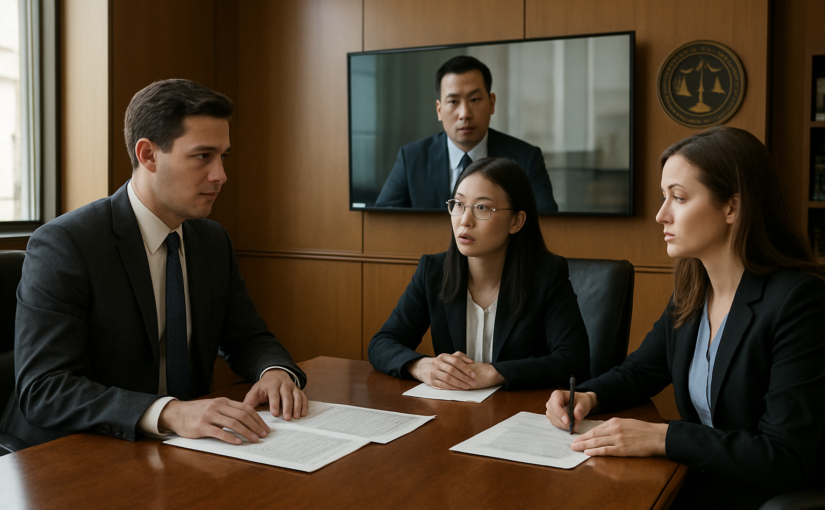
A Chinese certified interpreter can be a case-critical resource for California attorneys, paralegals, and in-house legal teams handling litigation, investigations, employment matters, and cross-border business disputes. In high-stakes settings, the right interpreter does more than bridge language differences between English and Chinese: they help preserve the record, reduce misunderstandings, support due process, and keep proceedings on schedule. This guide explains how California legal professionals can evaluate interpreter availability, understand common billing practices, select the right provider, and use best practices for depositions, mediations, attorney-client meetings, and remote proceedings.
California Demand, Demographics, and the Judicial Council Roster
Chinese remains one of the most in-demand languages in California legal matters, particularly in Los Angeles County, Orange County, San Francisco, Santa Clara, Alameda, and San Diego. The need spans Mandarin, Cantonese, and other Chinese varieties, with demand arising in civil litigation, family law, personal injury, employment, criminal defense support, internal investigations, and business disputes.
For court-related assignments, many legal professionals begin with the Judicial Council of California Master List, which identifies interpreters who are certified or registered by the state. When reviewing the roster, it is important to understand that availability can vary significantly by region, dialect, and proceeding type. Some interpreters primarily accept court assignments, while others are available for private depositions, arbitrations, or law firm meetings.
California attorneys should also recognize a practical distinction: not every matter requires the same credential profile, and not every Chinese-language assignment has equal coverage across the state. In some locations, there may be a stronger pool of Mandarin interpreters than Cantonese interpreters, and same-week scheduling can be difficult during busy court calendars. For that reason, firms should confirm not only whether an interpreter appears on the Master List, but also whether that interpreter is active, experienced in private legal work, and comfortable with the subject matter involved.
When evaluating roster availability, consider:
- Whether the interpreter is certified or registered and for which language designation
- Whether the assignment involves Mandarin, Cantonese, or another Chinese variety
- Whether the interpreter regularly handles depositions, witness preparation, or complex civil matters
- Whether travel to the venue is required
- Whether the matter may require consecutive, simultaneous, or sight translation skills
For legal teams under deadline pressure, relying on a roster search alone can be inefficient. A specialized agency can often identify qualified options faster, pre-screen for legal experience, and coordinate backup coverage if scheduling changes occur.
Typical Rates and Policies for a Chinese Certified Interpreter
Private legal interpreting rates in California vary by market, interpreter credentials, travel requirements, and case complexity. Although exact pricing differs by provider, law firms should expect most assignments to be billed on a half-day or full-day basis rather than by the minute. A half-day generally covers up to a set minimum block of time, while a full-day applies once that threshold is exceeded or reserved in advance.
For example, a straightforward attorney-client meeting may still be subject to a half-day minimum, even if the meeting lasts only 90 minutes. A deposition scheduled for six hours will usually be billed at a full-day rate. If the matter extends beyond the reserved period, overtime terms may apply.
Common policy points include:
- Half-day and full-day minimums: Many interpreters and agencies require a minimum booking block to reserve legal calendar time.
- Cancellation windows: A 24- to 48-hour cancellation policy is common. Late cancellations may trigger partial or full fees because the interpreter has blocked out the time and may be unable to replace the assignment.
- Travel time: If the interpreter must travel to a deposition site, law office, detention facility, or courthouse, travel time may be billed.
- Portal-to-portal billing: Some assignments are billed from the time the interpreter leaves for the location until the time they return, especially for distant venues.
- After-hours or rush scheduling: Evening, weekend, or urgent requests may carry premium rates.
- Remote appearance terms: Video assignments may still be subject to minimums, technical requirements, and cancellation rules.
California legal departments should request written confirmations that specify the language variety, date, start time, estimated duration, billing structure, cancellation terms, travel charges, and whether a check interpreter is recommended. This reduces disputes later and helps litigation teams budget accurately.
How to Find the Best Chinese Certified Interpreter
Finding the best Chinese certified interpreter requires more than verifying a credential. The strongest interpreter for a legal matter combines language accuracy, ethical discipline, procedural familiarity, and the ability to remain composed under adversarial questioning. In practice, the best fit is often the interpreter who matches the legal context, dialect needs, and sensitivity of the assignment.
Attorneys should evaluate candidates or vendors using several criteria:
- Experience in legal settings such as depositions, witness interviews, mediations, and trial preparation
- Fluency in the appropriate spoken variety, including regional usage where relevant
- Familiarity with legal terminology, objections, and procedural rhythm
- Ability to interpret verbatim rather than summarize
- Professional neutrality and confidentiality
- Reliability, punctuality, and responsiveness under changing schedules
This is where an agency such as L.A. Translation can provide a significant advantage. Instead of placing the burden on a paralegal or legal assistant to vet individuals one by one, an experienced agency can confirm credentials, match dialect needs, coordinate logistics, and document compliance requirements. That support is especially valuable when a deposition notice changes, a witness becomes available unexpectedly, or the original interpreter has a conflict.
Using an agency also helps reduce the risk of continuances and avoidable delays. If a matter cannot proceed because the wrong dialect was booked, the interpreter lacks legal experience, or the provider fails to appear, the cost can far exceed the interpreting fee. Delays affect attorney time, court reporter scheduling, expert coordination, and client confidence. A dependable agency helps prevent those disruptions by building redundancy into the scheduling process and by confirming assignment details before the event.
Why a Check Interpreter Matters in High-Stakes Testimony
In contested matters, a check interpreter can be essential. A check interpreter is a second qualified interpreter retained to monitor the interpretation for accuracy, completeness, and neutrality. This role is especially valuable during lengthy depositions, contentious witness examinations, and matters involving technical facts, disputed statements, or a witness whose credibility is central to the case.
The purpose of a check interpreter is not to disrupt the proceeding. Rather, it is to help protect the record. When testimony is being interpreted across English and Chinese, even small shifts in wording can affect meaning. A check interpreter can identify omissions, additions, paraphrasing, register changes, or errors that may become significant during impeachment or motion practice.
Situations where a check interpreter is often recommended include:
- Cross-examination of a key witness
- Cases involving nuanced admissions or disputed timelines
- Technical or industry-specific testimony
- Matters expected to generate transcript challenges
- Proceedings where one side wants additional assurance of verbatim fidelity
Consider a product liability deposition in which a Chinese-speaking engineer uses a term that could mean either “design tolerance” or “acceptable deviation” depending on context. If the interpretation drifts, counsel may build follow-up questions on the wrong premise. A check interpreter can flag the issue promptly, allowing counsel to clarify the testimony before the ambiguity hardens in the transcript.
For California litigators, the value is straightforward: better accuracy, a cleaner record, and fewer downstream disputes over what was actually said.
Best Practices for Depositions, Mediations, Attorney-Client Meetings, and Video Interpreting
Depositions
For depositions, book early and confirm the witness’s spoken variety of Chinese well in advance. Provide case-specific glossaries, names, technical terms, and pleadings if appropriate. Ask the interpreter to arrive early or join the video platform in advance for sound checks. Counsel should instruct all participants to speak one at a time, avoid overlapping objections, and allow the interpreter to finish each segment completely. This improves transcript quality and reduces the risk of incomplete answers.
Mediations
Mediations require a different skill set. The interpreter must handle rapid shifts between caucus sessions, emotionally charged exchanges, and settlement language that may be highly nuanced. Confidentiality and neutrality are critical. It is wise to brief the interpreter on the process structure, expected participants, and whether draft term sheets may require sight translation during the session.
Attorney-Client Meetings
In attorney-client meetings, precision and trust are paramount. Avoid using family members, staff without legal interpreting training, or bilingual acquaintances for substantive discussions. Privileged communications deserve professional handling. A qualified interpreter helps counsel explain rights, risks, timelines, and strategy clearly while reducing the chance of misunderstandings that later affect testimony or decision-making.
Remote Video Interpreting
Remote proceedings can be efficient, but they require planning. Use a stable platform, quality microphones, headsets where possible, and a quiet environment. Confirm participant names and roles at the outset. If exhibits will be used, send them in advance when permitted, or ensure they can be displayed clearly on screen. Build in short breaks for lengthy sessions, since audio fatigue can affect accuracy. For critical examinations, consider whether a remote format is appropriate at all, or whether in-person interpreting would better protect communication quality.
Across all settings, the same principle applies: language access should be treated as a strategic legal function, not a last-minute administrative task.
Final Guidance for California Legal Teams
Choosing a Chinese certified interpreter is ultimately about protecting outcomes. The right professional helps attorneys develop a reliable record, communicate effectively with clients and witnesses, and move matters forward without unnecessary delay. The wrong choice can create confusion, transcript disputes, scheduling failures, and even continuances.
California law firms and legal departments should verify credentials, confirm the correct Chinese variety, understand billing and cancellation terms, and consider a check interpreter when the stakes justify it. Most importantly, they should work with a provider that understands legal procedure, compliance expectations, and the operational realities of litigation.
If your team needs a dependable Chinese certified interpreter for a deposition, mediation, witness interview, attorney-client meeting, or remote legal proceeding, contact L.A. Translation today to secure qualified coverage and protect your case from avoidable language-access errors.