
The evolution of simultaneous interpretation (SI) equipment is a fascinating journey from clunky telephone wires to seamless, cloud-based digital platforms. By eliminating the massive delays of consecutive translation, this technology fundamentally transformed international diplomacy and global business.
Here is a breakdown of how the equipment has evolved over the past century:
1. The Early Days: The “Hushaphone” (1920s–1930s)
-
The Filene-Finlay System: In the mid-1920s, American businessman Edward Filene and British engineer A. Gordon-Finlay developed the first “telephonic interpreting” system, which they tested at the League of Nations.
-
How it worked: It functioned much like a telephone switchboard. Interpreters listened through basic headsets and spoke into microphones equipped with a “Hushaphone”—a mechanical funnel attachment designed to muffle their voices so they wouldn’t disturb the audience.
-
IBM’s Involvement: IBM’s founder, Thomas Watson Sr., acquired the patent in 1931. However, early on, the equipment was largely used to read pre-translated texts aloud at the same time the speaker was talking, rather than true on-the-spot interpretation.
2. The Breakthrough: The Nuremberg Trials (1945–1946)
-
The Ultimate Test: Following WWII, the Nuremberg Trials required a massive, real-time multilingual setup (English, French, Russian, and German). Using traditional consecutive interpretation—where a speaker pauses for the translator—would have caused the trials to drag on for years.
-
The IBM Setup: IBM provided a highly advanced, multi-channel wired system for free. Participants wore headsets and turned a dial to their preferred language.
-
The “Traffic Light”: Because audio quality was still spotty and speakers talked too fast, interpreters were given a switchboard that controlled a light on the speaker’s podium. They could flash a yellow light to tell the speaker to slow down, or a red light to tell them to stop and repeat. This historic event proved simultaneous interpretation was highly effective.
3. The Golden Age of Hardware: Infrared & ISO Standards (1950s–2000s)
-
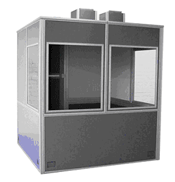
Permanent Installations: Following the success at Nuremberg, the newly formed United Nations heavily adopted the technology, building permanent, soundproof booths into their assembly halls.
-
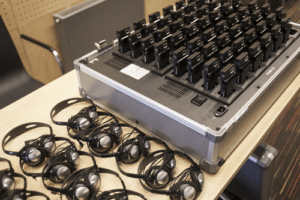
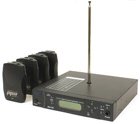
The Shift to Wireless: Early conference setups required miles of heavy copper wiring. By the late 20th century, the industry shifted to Infrared (IR) technology. Audio was transmitted via invisible light waves to lightweight, battery-operated receivers worn by attendees.
-
Standardization: As the profession grew, the International Organization for Standardization (ISO) established strict requirements for booth sizes, ventilation, and acoustic audio consoles to protect interpreters from “acoustic shock” (sudden loud feedback) and cognitive fatigue.
4. The Digital Revolution: Remote & Cloud (2010s–Present)
-
Remote Simultaneous Interpretation (RSI): The advent of high-speed internet and cloud computing paved the way for platforms like KUDO, Interactio, and later Zoom.
-
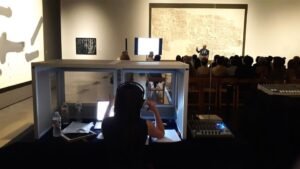
Software over Hardware: Heavy, physical mixing consoles have largely been replaced by “soft consoles” on laptops. Interpreters can now work from decentralized, specialized studio hubs—or even their own homes—relying on live video feeds instead of peering through the glass of a physical booth.
-
AI Integration: Modern setups are beginning to blend human interpretation with artificial intelligence. Digital interfaces now offer AI-assisted speech-to-text overlays that can automatically transcribe numbers, names, and technical terms on the interpreter’s screen in real-time to assist them while they speak.

Contact info@latranslation.com or 213-385-7781 to rent simultaneous interpreting equipment for your event.