Navigating the Global Stage: The Essential Guide to Renting Simultaneous Interpreting Equipment in Los Angeles
Los Angeles is far more than just the entertainment capital of the world; it is a sprawling, dynamic global crossroads. As a truly cosmopolitan city, the linguistic diversity found within its borders is staggering. According to recent demographic data, roughly 56.8% of the population speaks a foreign language at home, reflecting a rich tapestry of cultures from every corner of the earth. Furthermore, approximately 39.7% of the city’s residents consist of immigrants who have relocated to Southern California, weaving their native traditions and languages into the very fabric of the region.
Because of this unique demographic profile, communication in Los Angeles regularly transcends English. In 2025 alone, thousands of international conferences and meetings took place across the city, drawing global leaders, innovative entrepreneurs, and academic researchers. It is the ultimate dream of many international businesses to introduce their cutting-edge products and services to the massive, diverse audience in Los Angeles. However, executing a successful event in such a multilingual environment requires more than just a great venue and compelling slides—it requires bridging the language gap seamlessly.
When an event features English-speaking presenters alongside a sizeable number of participants who are not fluent in English and need interpreting, simultaneous interpreting becomes an absolute necessity. Unlike traditional translation, which deals with written text, or consecutive interpreting, where speakers pause to let the linguist talk, simultaneous interpreting happens in real time. It allows information to flow continuously without interrupting the natural rhythm of the speaker.
To achieve this fluid exchange of ideas, highly specialized audio hardware must be deployed. For event planners, corporate executives, and community organizers alike, understanding the logistics of renting simultaneous interpreting equipment is the key to executing a flawless multilingual event.
The Landscape of Multilingual Events in Southern California
The demand for high-end language services spans a wide array of sectors. On any given day in Southern California, corporate workshops, international trade summits, governmental forums, and educational seminars are actively running. Each of these events serves a different purpose, yet they all share a common requirement: clear, instantaneous cross-linguistic communication.
Academic and Corporate Sectors
Major educational institutions frequently host global symposiums that require highly specialized linguistic support. For example, prominent language service providers like L.A. Translation & Interpretation, Inc. have provided elite interpreters and advanced equipment rentals to tens of high-profile workshops and conferences held by elite universities, including the University of Southern California (USC) and the University of California, Los Angeles (UCLA). Whether it is a medical research breakthrough being shared at a university forum or a multinational tech company pitching its latest software to foreign investors, simultaneous interpreting equipment keeps the entire room aligned.
Entertainment and Film industries also need simultaneous interpreting when engaging international talents. Multinational Automobile companies and cosmetics companies, for example, conduct consumer research such as focus groups before launching their products in the U.S. Market and need accurate, high quality translators and equipment.
Community and Civic Engagement
Language access is not reserved solely for Fortune 500 corporate boardrooms or sprawling convention centers. It plays a vital role in local civic life and family milestones:
-
School Commencements: Graduation ceremonies are a prime example of where simultaneous interpreting is essential. When proud parents and grandparents travel from foreign countries to watch their loved ones walk across the stage, providing real-time interpretation in their native language ensures they can fully experience the speeches and celebrations.
-
Homeowners Association (HOA) Meetings: In linguistically diverse neighborhoods throughout Southern California, HOAs frequently need interpreters for important community meetings. When crucial decisions regarding property regulations, budgets, or local developments are on the line, every resident deserves a voice, regardless of their English proficiency.
- Weddings, Parties and Funerals: As true love transcends borders, there are many international weddings in Los Angeles which require simultaneous interpreting. It is considerate to provide interpreter for non-English speaking persons at the funeral, so that they can share the memories of the deceased.
- Local government hearings: County, City and State governments frequently hold hearings to aggregate public opinion and provide simultaneous interpreting
- Church sermons and religious gatherings: Many churches in Los Angeles provide simultaneous interpreting for congregation with limited English fluency.
Decoding the Equipment: Transmitters, Receivers, and Headsets
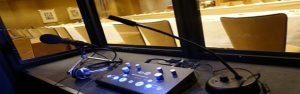
Simultaneous interpreting relies on a sophisticated “closed-loop” wireless audio network. The process begins when the floor speaker talks into the main microphone. That audio feed is routed directly into the interpreter’s headset. As the interpreter listens to the English source, they instantly speak the target language (such as Spanish, Mandarin, Korean, or Armenian) into an isolated microphone. This translated audio signal is then broadcast through a transmitter to the audience.
When planning an equipment rental, the choice of transmission technology depends directly on the layout of your venue and the size of your crowd.
1. Large-Scale Stationary Transmitters
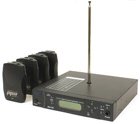
For sizeable events featuring more than 100 people, multi-channel stationary transmitters are utilized. These powerful units are connected directly to the venue’s main sound mixing board or the interpreters’ central control console. They plug into robust external antennas that blanket large banquet halls, hotel ballrooms, or auditorium spaces with a reliable audio signal, ensuring no dropouts occur even in a crowded room.
2. Portable Transmitters
For mobile settings or smaller gatherings of under 100 people, a portable transmitter is the ideal alternative. This compact, battery-powered device is typically worn on a lanyard or held by a tour guide or interpreter. It is incredibly effective for field workshops, factory tours, museum walkthroughs, or intimate breakouts where the group is constantly on the move.
3. Audience Receivers and Headsets
On the listening end, non-English speaking attendees are provided with lightweight, battery-operated wireless receivers paired with comfortable earphones or over-ear headsets. Attendees simply switch their individual receiver to the specific channel assigned to their language (e.g., Channel 1 for Spanish, Channel 2 for Mandarin) and adjust their volume. This allows them to listen to the speaker’s presentation simultaneously in their native language, maintaining identical pacing and emotional impact as the rest of the room.
The Role of Soundproof Booths in Simultaneous Interpreting
One of the most critical—yet frequently overlooked—components of an interpreting rental package is the acoustic containment system. Simultaneous interpreters must talk at the exact same time as the primary speaker. Without proper sound isolation, two major problems occur: the interpreter’s voice will distract the nearby audience members, and the ambient noise from the venue will leak into the interpreter’s microphone, muddying the translation feed.
To solve this, international conferences dictate strict guidelines regarding soundproofing. Depending on space constraints and budget realities, event planners can choose from a few standard options:
Full-Size Soundproof Booths
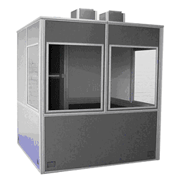
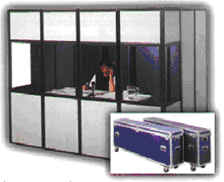
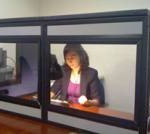
Most high-level international conferences and governmental summits require a full soundproof booth. These are walk-in structures designed to comfortably accommodate two or three interpreters for long shifts. They feature built-in ventilation fans, acoustic panels, and double-paned viewing windows so the linguists maintain a clear line of sight to the stage. These walls protect the interpreters from outside distractions while ensuring the surrounding audience won’t be bothered by the ongoing translation.
Desktop Glass Soundproof Booths
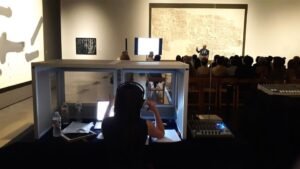
For smaller venues or intermediate groups of 100 people or less, a desktop glass soundproof booth can do a fantastic job. These are compact, three-sided or four-sided enclosures that sit on top of a standard banquet table. While they do not offer the complete acoustic isolation of a walk-in unit, they effectively block a significant amount of forward-facing sound. It is a highly practical solution that is exponentially better than having no booth at all.
Portable Travel Booths and Boothless Options
Some non-governmental organizations (NGOs) operating with small groups, such as a localized HOA meeting or a small neighborhood council, wouldn’t require a heavy, full-sized booth. In these intimate settings, the interpreter can utilize a highly lightweight, portable tabletop shield, or bypass the booth entirely by sitting in the back of the room with a portable transmitter, speaking in quiet whispers to minimize audio bleed.
Simultaneous vs. Consecutive Interpreting: Which Do You Need?
A common mistake when organizing a multilingual meeting is confusing simultaneous interpreting with consecutive interpreting. Renting an array of transmitters and headsets is only necessary if your audience layout warrants real-time transmission.
| Feature |
Simultaneous Interpreting |
Consecutive Interpreting |
| Timing |
Real-time, continuous delivery. |
Step-by-step; speaker pauses for the interpreter. |
| Hardware Needed |
Transmitters, receivers, headsets, and booths. |
Standard microphone and PA system (if any). |
| Audience Profile |
Mixed crowd (some English speakers, some non-English). |
Uniform crowd (the entire audience speaks the same foreign language). |
| Event Duration |
Normal runtime; no extra time added. |
Doubles the required presentation time. |
If the entire audience is a foreign-language-speaking group and there are no English speakers in attendance except the presenter, then consecutive interpreting is typically required. In this setup, the speaker delivers a few sentences in English, pauses, and the interpreter steps up to replicate those sentences in the target language. Because everyone in the room needs to hear the exact same translation sequentially, specialized wireless headsets and soundproof booths are completely unnecessary.
Partnering with an Experienced Industry Leader
Renting interpretation gear is not a simple DIY project. It requires meticulous audio engineering, precise frequency coordination to prevent wireless interference, and deep expertise in matching the right equipment to the specific venue dynamics.
When execution matters, turning to an established local institution is vital. L.A. Translation & Interpretation, Inc. has proudly provided top-tier interpreting services and professional equipment rentals for over 23 years, serving Southern California consistently since 2003. Their decades of hands-on experience ensure that your corporate summit, academic workshop, or community meeting receives the exact technical layout required for crystal-clear, uninterrupted communication.
By investing in the correct transmitter configurations, choosing appropriate acoustic booths, and aligning with seasoned professionals, your organization can break down language barriers and tap into the vibrant, cosmopolitan potential that makes Los Angeles a premier destination for global business.