
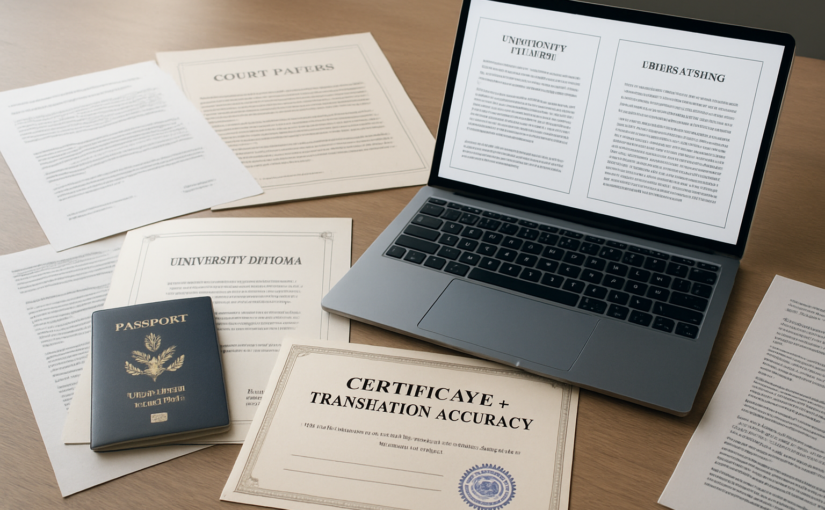
Certified Spanish Legal Translation: Why Accuracy Is Not Optional
When you need a certified Spanish legal translation, you are not simply converting words from English into Spanish or from Spanish into English. You are preparing a document that may be reviewed by courts, law firms, government agencies, opposing counsel, or compliance teams. In legal settings, even a small terminology mistake can delay a filing, weaken a contract review, or cause a document to be rejected altogether.
That is why legal translation requires more than bilingual fluency. It demands precision, consistency, subject-matter familiarity, and a certification process that supports the translation’s intended legal use. Whether you are submitting a contract in discovery, translating an affidavit for immigration or civil litigation, or preparing court documents for attorney use, choosing the right provider is critical.
What Is a Certified Spanish Legal Translation?
A certified Spanish legal translation is a translation accompanied by a signed statement attesting that the translation is complete and accurate to the best of the translator’s knowledge and ability. This certification is often required for official or legal purposes, especially when documents will be filed with a court, submitted to a government body, or reviewed by counsel in a formal matter.
Certified translation does not mean the translator is guaranteeing the legal outcome of your case. It means the translation provider is formally affirming the accuracy and completeness of the translated content. Depending on the jurisdiction or receiving institution, additional requirements may apply, such as notarization, formatting rules, translator credentials, or original-signature certification pages.
Documents That Commonly Require Certified Spanish Legal Translation
- Commercial contracts and service agreements
- Employment agreements and non-disclosure agreements
- Court complaints, answers, motions, and exhibits
- Affidavits, declarations, and sworn statements
- Power of attorney documents
- Settlement agreements
- Corporate formation and compliance records
- Immigration-related legal documents
In each of these categories, terminology matters. A mistranslated clause in a contract can change obligations. An inaccurate court filing can create procedural complications. A poorly translated affidavit can undermine credibility. For that reason, a legally reliable certified Spanish legal translation should be prepared with the same care as the original document.
How to Translate Contracts Without Rejection
1. Preserve the legal meaning, not just the wording
Contracts are full of defined terms, conditional language, limitation clauses, indemnification provisions, and jurisdiction-specific phrasing. A literal translation may sound correct while still distorting the legal effect. The translator must understand how contractual language functions and render it accurately in the target language.
2. Keep terminology consistent
If a party is identified as “Seller” in one section, it should not become “Vendor” or another near-equivalent later unless the original changes. Defined terms, dates, section headings, and references must remain consistent throughout the translation. Inconsistency is a common reason legal teams question a translation’s reliability.
3. Maintain formatting and structure
Numbering, signature blocks, tables, exhibits, and clause hierarchy should mirror the original as closely as possible. Lawyers and courts often compare the translation against the source document line by line. A clean structure reduces confusion and supports faster review.
How to Translate Court Documents Correctly
Court documents require especially careful handling because procedural precision matters. Complaints, motions, orders, subpoenas, and evidentiary exhibits often contain citations, captions, deadlines, and case-specific terminology. A qualified legal translator should preserve names, docket references, seals, stamps, handwritten notes, and illegible text markers where appropriate.
For a certified Spanish legal translation used in litigation, it is also important to avoid unauthorized editing. The translator should not “improve” the original or omit awkward language simply because it reads poorly. The translation must reflect the source faithfully, including errors, unusual formatting, or incomplete text, typically with translator notes where necessary.
How to Translate Affidavits and Sworn Statements
Affidavits and declarations are highly sensitive because they present facts in a sworn format. The tone, first-person voice, dates, and factual assertions must be translated exactly. Any ambiguity introduced in translation can raise questions about the declarant’s intent or credibility.
When translating affidavits, the certification page becomes especially important. Attorneys, courts, and agencies may expect a signed certification confirming that the translation is complete and accurate. If the affidavit will be used internationally, ask in advance whether notarization or apostille-related support is required.
Common Reasons Legal Translations Get Rejected
- Missing certification statement
- Inaccurate or inconsistent legal terminology
- Omitted text, stamps, initials, or attachments
- Poor formatting that does not match the original
- Use of unqualified translators with no legal experience
- Failure to meet court or agency-specific submission rules
Many rejections are preventable. The safest approach is to work with a provider experienced in certified Spanish legal translation and to confirm the end-use requirements before the project begins.
What to Look for in a Certified Spanish Legal Translation Provider
- Experience with contracts, litigation documents, and affidavits
- Clear certification procedures
- Strong quality control and proofreading
- Confidential handling of sensitive legal materials
- Ability to preserve formatting and supporting exhibits
- Responsiveness to attorney or court instructions
You should also ask whether the provider has handled documents for courts, law firms, in-house counsel, or regulated filings. Legal translation is a specialized service, and the stakes are too high for generic translation workflows.
Final Thoughts
If your document will be scrutinized in a legal setting, do not leave accuracy to chance. A professional certified Spanish legal translation helps ensure that contracts, court documents, and affidavits are translated faithfully, presented properly, and accepted for their intended use. The right translation partner can reduce delays, protect legal meaning, and give attorneys and decision-makers confidence in the record.
Before ordering, verify the receiving party’s requirements, provide complete source files, and request certification in the exact format needed. In legal matters, precision is not a luxury. It is the standard.
—